
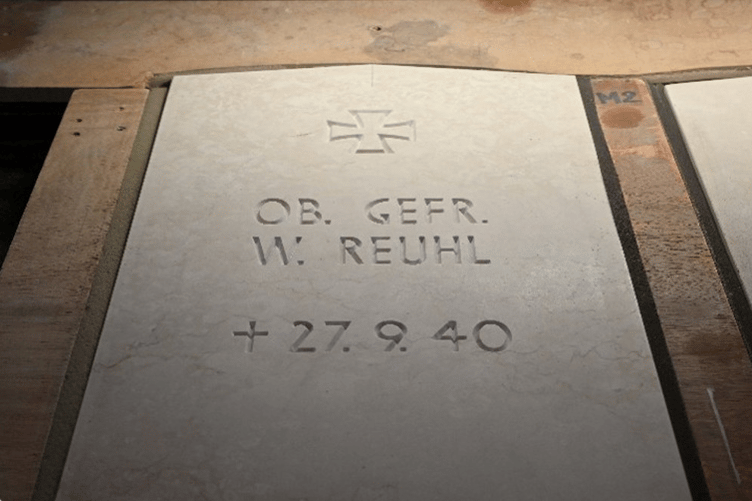
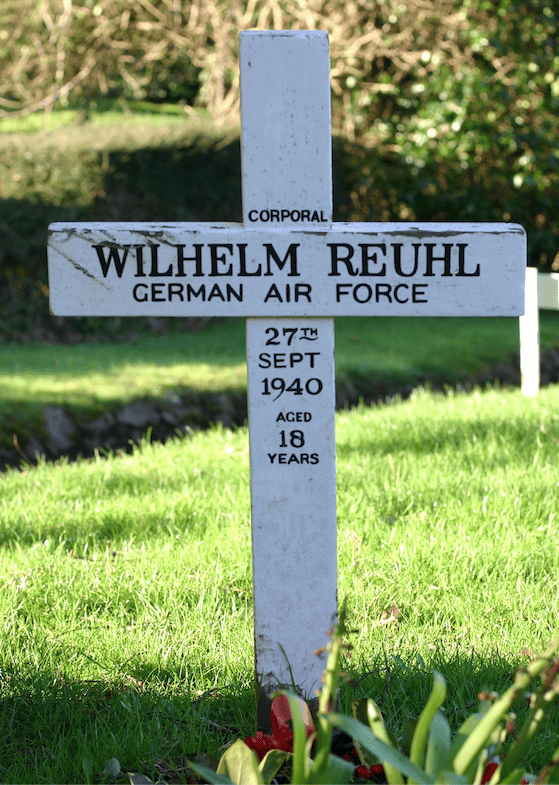
A REDEDICATION ceremony is being held in Porlock this week to mark the installation of a headstone on the grave of a German airman shot down 86 years ago during World War Two.
Wilhelm Reuhl died when his Junkers 88 was brought down by RAF Spitfires over the West Somerset coast in September, 1940.
Three other Luftwaffe crew survived the crash in Porlock Bay, but Reuhl, aged 20, a gunner, was found dead in the wreckage the next day.
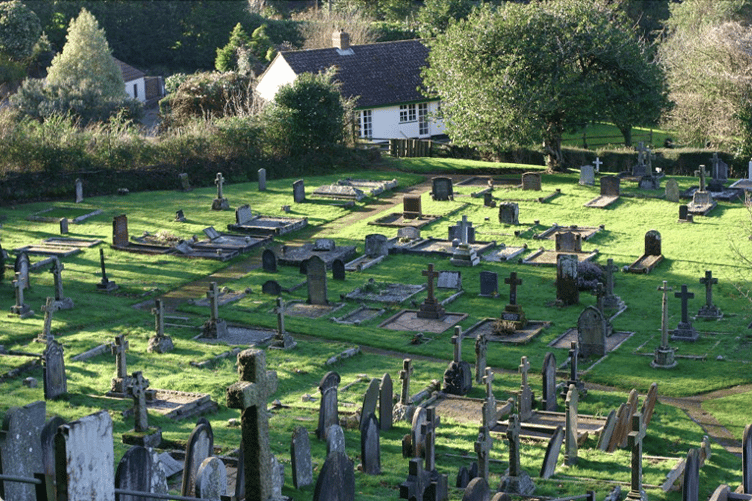
He was buried with full military honours in the cemetery in Hawkcombe, on the edge of Porlock, and his grave has been tended ever since by villagers.
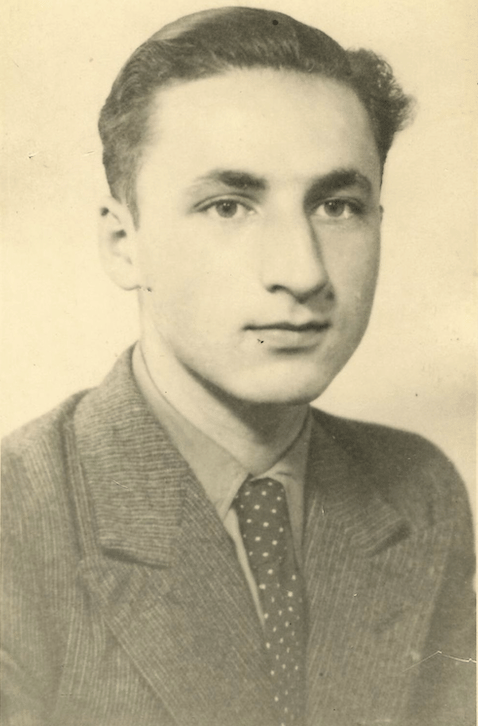
The care and respect shown by Porlock residents was why Reuhl’s family did not want his remains moved to the Cannock Chase German Military Cemetery, in Staffordshire, where nearly 5,000 of his countrymen were eventually interred.
A simple wooden cross has marked Reuhl’s grave but now the Volksbund Deutsche Kriegsgräberfürsorge (VDK), Germany’s equivalent of the Commonwealth War Graves Commission (CWGC), has commissioned a headstone to ensure a permanent military commemoration and the dignity afforded to all war dead, regardless of nationality.
It will be installed on Thursday (August 13) after a service in Porlock’s St Dubricius Church to be attended by representatives of both the CWGC and VDK.
The service will celebrate an ‘extraordinary story of reconciliation, compassion, and enduring friendship’ between communities in Britain and Germany.


Reuhl’s family will not be attending the occasion, but his niece Sabine Reuhl said: “Although Wilhelm’s young life was cut short by war almost 86 years ago, our family has never forgotten him.
“This end marked the beginning of a new, different story, one full of hope and comfort.
“The people of Porlock tended his grave, laid flowers, read out his name on Remembrance Day, contacted his parents and cared for him as if he had been their own deceased son or brother, even though he had come to their country as an adversary.
“This empathy and outpouring of sympathy brought great comfort to our family.
“I would like to express my heartfelt thanks to the residents, the parish council of Porlock, to the parish of St Dubricius, to the Commonwealth War Graves Commission, and to the Volksbund for this ‘cross-border’ project and ensuring Wilhelm’s grave is marked with a headstone.”
German Ambassador Susanne Baumann said: “Porlock tells a particularly remarkable story of British-German reconciliation.
“It is deeply moving that the grave of a German airman who fell in Porlock Bay as an enemy has been so faithfully tended by the local community for over 86 years.
“The people of Porlock have demonstrated, through this extraordinary act of reconciliation, the values that unite us today, including the belief in a dignified burial for every human being.
“I am profoundly grateful for this farsighted act of friendship.”
Heinrich Wilhelm Reuhl, known as Wilhelm, was born on July 4, 1920, in Bischofsheim, in the district of Hanau, as the son of civil engineer Wilhelm Reuhl and his wife Margareta.
He had a younger sister and a younger brother.
Reuhl developed a keen interest in building model gliders in his youth and later learned to fly gliders.
He attended the Oberrealschule, in Frankfurt, and, after graduating in April, 1938, took up a position as a trainee at a machine tool factory, but after the outbreak of war he was called up into the Wehrmacht in October, 1939.
Training in the Weimar-Nohra air base was followed by pilot training school at the Brandis-Waldpolenz airfield, in Saxony, and a transfer in June, 1940, to the theatre of operations in western France.
During ‘The Blitz’, Lance Corporal Reuhl was an onboard mechanic on reconnaissance flights over England.
On September 27, 1940, he was a gunner on a Junkers 88 fighter aircraft equipped with high-resolution photographic equipment on a reconnaissance flight targeting the port in Manchester.
However, the Junkers did not make it that far and was intercepted over Bristol by three British Spitfire fighters and chased down the coast as far as Porlock.
Following Thursday’s ceremony, the CWGC will continue to maintain Reuhl’s grave on behalf of the Federal Republic of Germany.
The partnership between the CWGC and the Volksbund is one of Europe’s longest-standing examples of post-war co-operation.
The Porlock event will highlight the shared commitment of both organisations to preserving the memory of those who died in conflict and promoting understanding of the human cost of war and the value of peace.
Comments
This article has no comments yet. Be the first to leave a comment.