
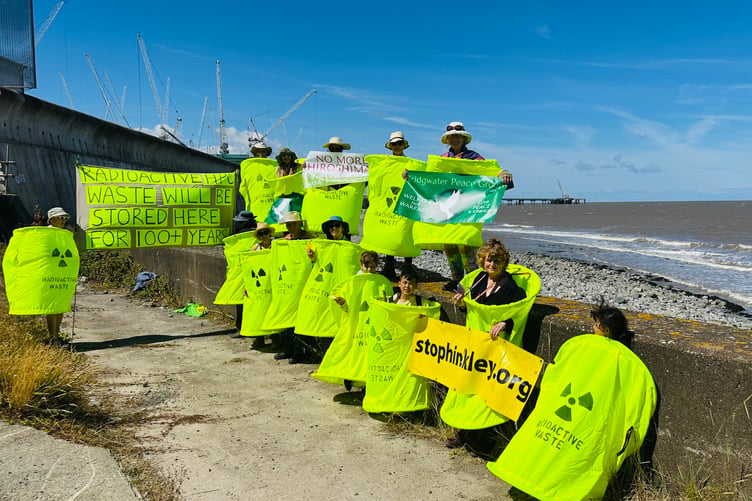
ANTI-nuclear campaigners staged a protest near the cluster of Hinkley Point power stations on the West Somerset coast on Thursday (August 6) to coincide with ‘Hiroshima Day’.
It was the 81st anniversary of the dropping of the world’s first nuclear bomb on the Japanese city in 1945.
Members of the Stop Hinkley group gathered beneath the Hinkley Point sea wall to also highlight how nuclear waste would be stored on the site for centuries.
Stop Hinkley has been focussed on holding Hinkley C owner EDF to account for the protection of the public, wildlife, and the environment since the early 1980s.
The building of Hinkley C was initially blocked by Margaret Thatcher in 1984 because it was considered financially unviable.
It was eventually given the go-ahead under Theresa May’s Government in 2016.
One campaigner, Katy Attwater, from Timberscombe, said: “I have been campaigning against the building of Hinkley Point C nuclear power station since 2008 when I joined this amazing local protest group.
“We felt Thursday was an appropriate day to be reminded, given the danger of nuclear energy and its deadly by-product, highly-reactive spent fuel, which requires isolation for thousands to hundreds of thousands of years - nobody actually knows how long.
“We wished to draw attention to the danger arising from the radioactive waste that will be stored on site at Hinkley Point for at least 100 years.
“This was not envisaged at the outset, but, due to Sellafield no longer accepting high level nuclear waste and the continuing failure to find a site for a geological disposal facility (GDF), aka ‘nuclear dump’, there is nowhere for it to go.”
 Developer promises 48 council homes in Cannington if 160-house estate is approved
 MP says things need to be done differently to solve country's social care crisis
 From 'quack pack' to hounds, falconry, and vintage tractors at Dunster Country Fair
 Impromptu 'Happy Birthday' by villagers surprises Kilve's oldest resident
Ms Attwater said Hinkley C would have a scheduled refuelling outage every 12 to 24 months when about one-third of the nuclear reactor’s core 241 fuel assemblies were taken out and replaced with fresh fuel.
She said: “These assemblies, fuel rods, are so highly radioactive that they have to be stored under water for 10 years before they can be moved.
“There is currently no solution in the planning stage for where this hot and deadly substance can be taken.
“With predicted sea level rises and extreme weather events, this process will become increasingly dangerous on the low-level eroding coastline of Hinkley Point.
“We would encourage people to contact their local MPs to ask why this is being allowed to proceed, especially in the context of the obvious acceleration of climate change on our beloved planet earth.”
The Hinkley Point site houses three nuclear power stations, A, B, and C.
Hinkley A, opened in 1965 and was shut down after 35 years in 2000, and is currently being decommissioned by the Nuclear Decommissioning Authority subsidiary Magnox Ltd.
It will store intermediate level waste on site until a GDF becomes available.
The B station opened in 1976 and ceased generation in 2022 and has had its fuel removed and taken to Sellafield.
Decommissioning is expected to be approved in October this year.
Hinkley C is under construction and expected to start generating power in 2029.
Comments
This article has no comments yet. Be the first to leave a comment.