
A SENIOR police officer has explained why the M5 motorway through Somerset has so often been closed this year and why closures for a ‘serious incident’ take so long to resolve.
National Highways classes a ‘serious incident’ as one which shuts a lane on one of the carriageways, including for dealing with ‘a person in crisis’.
Avon and Somerset Constabulary ultimately holds responsibility for deciding how much of the motorway should be closed, and for how long.
National Highways, which recently made a public apology for the frequency and length of closures this year, deploys teams to carry out urgent repairs once a scene has been cleared.
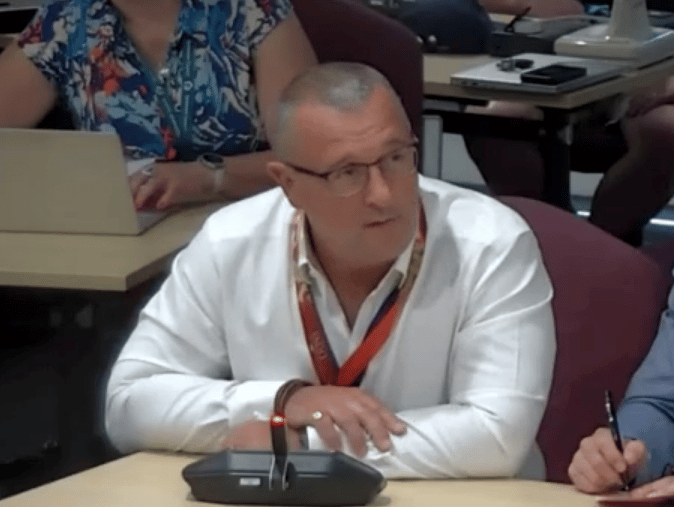
Now, police forensic collisions investigation lead officer Insp Andy Roebuck has told Somerset councillors why investigations can be so lengthy.
Insp Roebuck warned any attempt to speed up the process could undermine a criminal prosecution.
He said: “We are the people that will turn up at the scene of somebody who has tragically been killed, or has such injuries that they are not expected to live.
“We have to operate to what the coroner’s judicial requirements are, along with those from a criminal investigation point of view.
“At some of the incidents we attend, there has been fault, there has been criminal acts, and you can be sentenced for up to 20 years.
“So far this year, we have attended 45 incidents in the Avon and Somerset area, of which there has been 32 people killed.


“My highly qualified team of 13 people deals with a high level of death, more than the wider force does.
“Our average time at a scene this year has been just under five hours.
“I accept the road would have been closed longer, because as soon as the first emergency units attend, they put a road closure on, which is quite right for their safety and the preservation of evidence at the scene.
“We have stringent rules of how we should be operating.
“If we operate incorrectly, then we could actually forfeit what could be a criminal investigation.
“With murder scenes, invariably you can have those areas closed off for a good few days.
“We only have one opportunity, because we have to reopen the road as soon as we possibly can.
“We are constantly looking at trying to reduce the road closures by using new technology or innovation.”
He said the force was underfunded compared to others in the UK, although such incidents would not go away simply by allocating extra funds.
More money would help, but it needed the council and other public services to prioritise and deal with their respective areas.
Insp Roebuck said: “The primary driver for the work we do is for the families, to give hopeful answers and closure to the families and the survivors.
“Behind every road death, there is a degree of tragedy, there are always other things that are happening.
“For us to operate differently and do less would need a change in legislation, and a change in the coroner’s judicial system as it currently stands.”
Comments
This article has no comments yet. Be the first to leave a comment.