
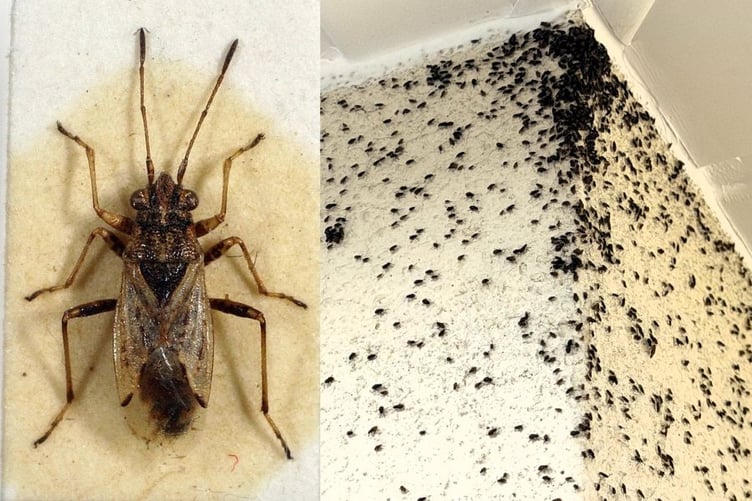
RESIDENTS in Blue Anchor are being asked to relive the nightmare experience of their homes being invaded by millions of bugs this summer as part of a parish council strategy to combat any future such attack.
From mid-August to early September, houses mainly on the western side of the hamlet were smothered in tiny brown insects which were believed to have come from nearby oilseed rape crops.
One householder said: “We spent days using hoovers and hosepipes trying to keep the bugs out.
“At one point, the front of the house was solid black with them.
“We looked online trying to figure out what to do, and the general advice was to douse them with soapy water.
“This was initially effective buts thousands more were waiting to take their place.”
Another resident said: “They swarmed into the rooms, climbing up curtains and making the carpets look as though they were moving.
“It was like something out of a science-fiction movie.
“They arrived in waves as the sun came up, became very active around mid-morning, seemed determined to get into the house, and then disappeared in the evening to get ready for another attack.”
The insects, which also invaded other communities, including Washford, Minehead, and Milverton, were identified as immature seed bugs of the Nysius species known as false chinch bugs and have a lifespan of two to three weeks.


Now, two Carhampton parish councillors, Emma Weaver and Tim Taylor, are carrying out research to identify the cause and source of the infestation.
They said: “We have contacted various organisations and the agents of the two owners of farmland around Blue Anchor.
“The Animal and Plant Health Agency (APHA) has been sent specimens and is arranging DNA tests to identify the exact species.
“Nysius species are not considered to be a pest, so APHA will probably do nothing.
“But, it has been responsive to the comment that such a large infestation of nymphs must have developed from eggs by feeding on plants, very likely crops, and this may well have reduced crop yields.”
The bugs are thought to be harmless to humans and present a ‘nuisance’ rather than a ‘health hazard’.
They do not fly as nymphs but become airborne when mature.
Research has shown the sustained hot and dry weather this summer could have been a key factor in the infestation, as Nysius species are known to thrive in such conditions.
Cllrs Weaver and Taylor said: “While we await further information on the bugs we would like to collect data to help with future preparedness and build a picture of the event.”
Residents are asked to supply information on the location of their property, its colour, and which areas were most affected, the duration of the infestation and the times of day when it was at its worst.
The study is also seeking information on what measures and controls worked or did not work when faced with the infestation.
Residents who suffered from the bug invasion should email to [email protected].
Comments
We've recently changed our login process. If you have an account for commenting, you will need to re-register on the login window.
This article has no comments yet. Be the first to leave a comment.