

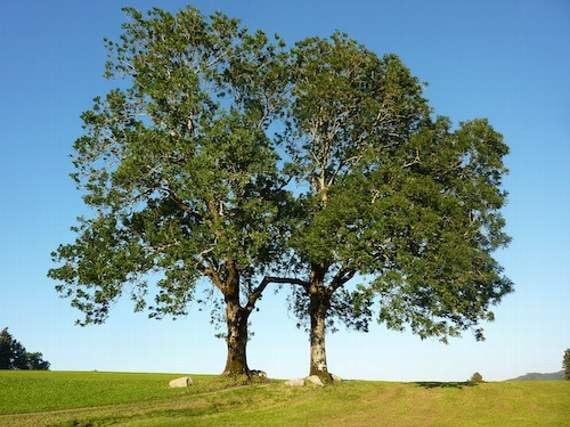
A TOTAL of 135 ash trees in a plantation near Dulverton, subject to a tree preservation order, are a danger to nearby houses, roads and communication and power lines, and should be felled, Exmoor National Park planning committee will be told at their meeting on Tuesday (January 7).
Many of the trees – in the park authority’s Newgate Plantation – are infected with ash dieback disease.
Should the application be granted, they will be felled in the coming spring and replaced with Forestry Commission-approved broad-leaved species.
Recommending the removal of the trees, case officer Graeme McVittie told the planning committee that they were in a narrow band of dense woodland behind Heronswood and Barle View and formed part of the park authority’s Newgate Plantation in a Site of Special Scientific Interest.

Mr McVittie said the application was the result of an ash tree in the plantation falling down last summer, bringing down an 11kv overhead power line and cutting off electricity for the whole of Dulverton.
“The cause of failure was almost certainly root decay brought about by honey fungus, but during inspections it was revealed that a large number of mature ash trees had early signs of ash dieback,” Mr McVittie said.
He added: “These trees were within falling distance of high value targets, including several permanently occupied properties, an overhead power line, telecommunications, highways and footpaths.”
There had been no objection to felling plans from nearby residents, local councils, the Environment Agency and Natural England.
But protected species, including bats, had potentially been recorded in the plantation and it was recommended that a bat ecologist surveyed the trees to confirm potential bat presence and advise on what further measures could be necessary.
Mr McVittie told the committee that access to the diseased trees was very restricted and removal would involve tree-climbing and dismantling \ felling techniques.
He said that, as ash dieback progressed and timber became brittle, felling options became increasingly limited, escalating risk to property and infrastructure.
“The application seeks to fell these trees in spring 2020 before ADB advances beyond a 25 per cent threshold and therefore presenting an unacceptable risk.
“Taking this course of action also allows for a full range or arboricultural techniques to be considered for the trees’ removal and the recommendation is that members approve the application,” Mr McVittie added.
Comments
This article has no comments yet. Be the first to leave a comment.