
PLANS to reintroduce white-tailed eagles, commonly known as sea eagles, to Exmoor appear to have stalled.
Exmoor National Park Authority (ENPA) consulted on the project a year ago and has since been waiting for the go-ahead from Natural England, which issues licences for species returns.
ENPA has been working on the species reintroduction with the Roy Dennis Wildlife Foundation (RDWF) and Forestry England.
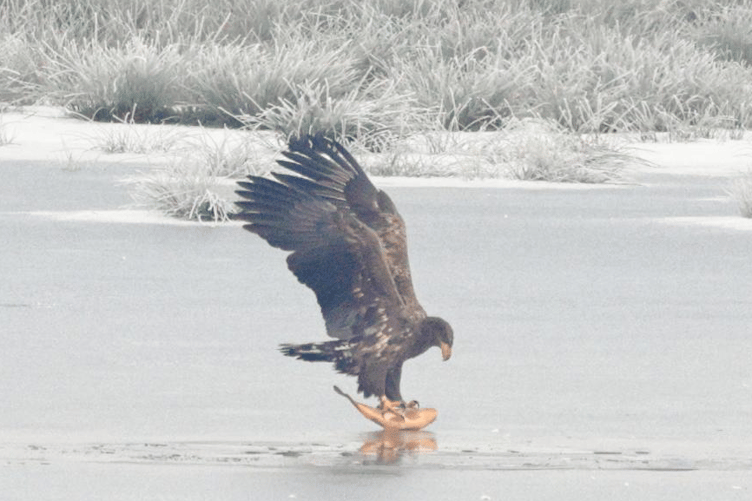
Exmoor has become a ‘hotspot’ for white-tailed eagles with up to eight birds regularly visiting in the past five years since their release on the Isle of Wight.




Three chicks also successfully fledged in Southern England last summer.
An RDWF spokesperson said: “All of the eagles are tagged so we can keep up to date with their progress.
There are plans to bring back sea eagles on Exmoor after more than 200 years,
“We look forward to seeing if the chicks will follow the flight path of their predecessors and visit Exmoor.”
White-tailed eagles were said to have been lost to Exmoor more than 200 years ago as a result of persecution by gamekeepers, farmers, and collectors.
Now, the park authority hopes to release 20 juvenile birds over a three-year period in the hope they will breed on Exmoor.
An ENPA spokesperson said: “We are still waiting on the decision from Natural England, could be end of January now, but we are not certain.”
Sea eagles are the UK’s largest bird of prey with a wingspan of more than eight feet (2.5 metres) and used to breed on the Exmoor coast until the 1700s.
Data shows the survival rate of young birds is only about 48 per cent, the causes of death ranging from poisoning, avian influenza, and train and power cable strikes, which means a number of eagles need to be released to ensure a breeding pair can establish themselves.
An Exmoor Society spokesperson said: “The extensively wooded coast of Exmoor, with abundant available fish such as mullet and sea bass, provides an ideal breeding habitat and there is strong evidence to show that white-tailed eagles bred here in the past.
“Although there is some concern from farmers, there are no instances of white-tailed eagles taking live lambs in their European range, though there have been cases in Scotland, but this may be due to a lack of alternative food.
“The eagles develop a preference for fish in their diet as they mature, rising from less than 10 per cent at one year old to approximately 35 per cent at five years.
“Small mammals are a major part of the diet when young, but this significantly decreases over time.
“They also eat other birds, particularly rooks, crows and jackdaws, and wetland species, such as mallard.”
More than 2,000 people took part in last year’s ENPA sea eagles consultation, of whom 80 per cent were in support of the reintroduction of the birds.
But there were many concerns, particularly among farmers, who feared the eagles would take young livestock, with feelings running high.
At least one public meeting where people attended to hear from those behind the project was said to have become quite rowdy.
Comments
We've recently changed our login process. If you have an account for commenting, you will need to re-register on the login window.
This article has no comments yet. Be the first to leave a comment.