
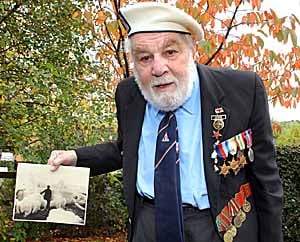
ROYAL Navy veteran Peter Baker braved sub-zero conditions and risked his life to help transport vital supplies to Russia during World War Two's notorious Arctic convoys more than 70 years ago.
But the Kilve pensioner, who will celebrate his 90th birthday in February, has been told that the UK Government is blocking Russia's attempt to honour the courage and sacrifice he made to help fight off the advance of Hitler.
The Russian Federation wants to award the Arctic convoy heroes the Medal of Ushakov as a symbol of the country's gratitude.
But Britain's Foreign Office has said that it would break the rules surrounding the acceptance of medals.


.jpeg?width=209&height=140&crop=209:145,smart&quality=75)
It says permission to accept a foreign award cannot be given if a UK award has been given for the same services - Arctic convoy veterans are eligible and most received the Atlantic Star.
However, that medal was created for a separate naval campaign and does not specifically recognise the actions of the convoy veterans between 1941 and 1945.
The Foreign Office also says that for a foreign award to be accepted, there has to have been specific service to the country concerned within the previous five years.
Mr Baker, who was still a teenager when he sailed in the first ever convoy to Russia's Archangel in August 1941, has described the UK Government's stance as "an absolute disgrace".
"I made countless trips and in fact I served on patrols, convoys and other operations in Arctic waters from 1940 to 1943," he said.
"The conditions were exceedingly inhospitable to say the least. We were at sea in temperatures well below freezing, often for 35 days at a time.
"It was extremely hard for everyone."
More than 66,000 British sailors and merchant seamen took part in the convoys.
As many as 3,000 lost their lives and many more had limbs amputated after suffering frostbite.
What has angered the remaining veterans even further is that Australia, Canada, New Zealand and the USA have all granted permission for their nationals to accept the award.
"There are only about 216 of us left in Britain and we are all in our 80s and 90s," said Mr Baker.
"It seems the Russian people think more of us and are more grateful for what we did than our own Government.
"It's absolutely unbelievable."
Less than a fortnight ago Mr Baker received a letter from Russian ambassador Alexander Yakovenko detailing the UK Government's response.
Mr Yakovenko said he could only express his profound regret that the British heroes could not be honoured in the same way as their counterparts in Australia, Canada, New Zealand and the USA.
"We hope this is not the end of the story," he wrote.
"The very uniqueness of what you did in World War Two means that due to that, nobody of succeeding generations has had to go through such trials.
"I wish to express to you once more on behalf of the people of Russia and the Russian Government our profound gratitude for your heroism and courage.
"That comradeship-in-arms, forged at a critical point in European and world history, will continue to be a key positive factor in our bilateral relationship as well as Euro-Atlantic affairs overall.
"I assure you that the embassy will continue to make the case for this award before the British authorities."
Mr Baker has written to West Somerset MP Ian Liddell-Grainger in the hope that he will take up the issue and fight the veterans' cause.
Although he has yet to receive a reply, Mr Liddell-Granger told the Free Press this week that he had spoken to Minister of State for the Armed Forces Andrew Robathan.
"This is a travesty," said Mr Liddell-Grainger.
"These men were the bravest of the brave. They saved countless lives and to treat them in this way is abominable.
"If we have to change the rules on the acceptance of medals then that is what we have to do.
"These veterans have waited more than 70 years for this honour and we should not be standing in the way of them receiving it.
"Something needs to happen and quickly."
Comments
This article has no comments yet. Be the first to leave a comment.