

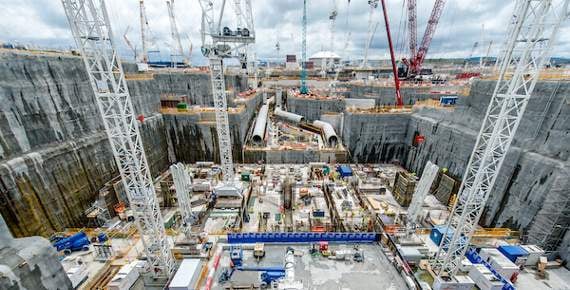
WORK has started at Hinkley Point C to install the 38,000 concrete segments needed to support the three underground marine tunnels at up to 33 metres below the seabed of the Bristol Channel.
Once complete, the tunnels will form a critical part of Hinkley Point C’s cooling system and will have the capacity to transfer 120,000 litres of water per second.
Rob Jordan, Hinkley Point C construction director said: “The start of tunnelling at Hinkley Point C represents a hidden but vitally important milestone in the construction of the UK’s first new nuclear power station in a generation.
“The achievement underlines the continued progress being made to ensure that Hinkley Point C will be ready to supply the UK with the reliable low carbon electricity that it needs to combat climate change.”
.jpeg?width=209&height=140&crop=209:145,smart&quality=75)
-Rachel-Gilmour-MP-Gideon-Amos-MP-Ashley-F.jpeg?width=209&height=140&crop=209:145,smart&quality=75)


Hinkley Point C will be the first power station in the Bristol Channel to include fish protection measures.
In a first for the UK and made at Balfour Beatty’s manufacturing facility in Avonmouth, pre-fabricated nuclear-grade concrete segments will be constructed to ensure that each of the three tunnel-boring machines is able to deliver significant efficiency savings whilst excavating over 11 tonnes of rock per minute.
The first machine has been named ‘Mary’ by local primary school children. This was in honour of Mary Anning, a local palaeontologist and fossil finder who lived her life in Lyme Regis.
The 1200 tonne machine, able to reach a maximum speed of 120mm per minute, will be run by 12 operators including a pilot, with supporting teams at the surface. The team includes industry experts along with apprentices and graduate students playing a vital role in its success.
Comments
This article has no comments yet. Be the first to leave a comment.