
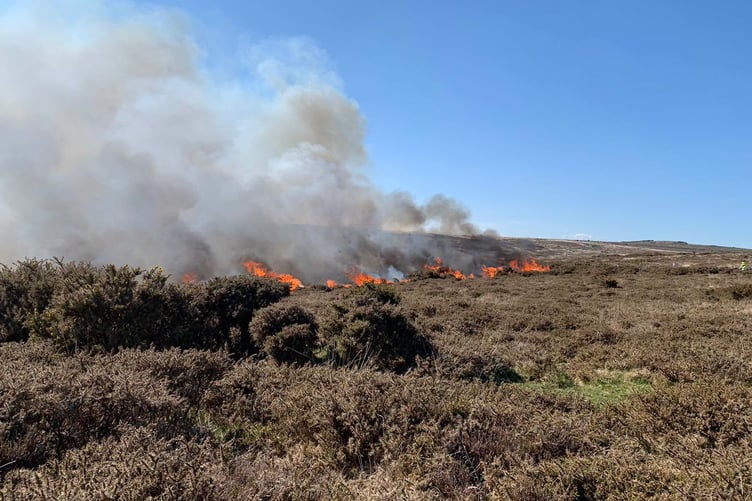
FIRE and rescue services are being ‘stretched to breaking point’ by this summer’s unprecedented wildfires season, Exmoor farmer and political campaigner James Wright said.
Mr Wright used Freedom of Information questions (FoIs) to reveal that a shortage of on-call firefighters was affecting Devon and Somerset Fire and Rescue Service (DSFR).
He learned that in 2204, the most recent year with figures available, the brigade’s full-time fire engines were available nearly 99 per cent of the time.
However, its on-call fleet, which forms the backbone of brigade cover in the countryside, was only about 80 per cent.
Mr Wright said it meant that at any given time, roughly one in five on-call fire engines could not respond to calls.
The reason recorded was almost always shortage of crew, with gaps widest in fire stations closest to Exmoor.
He said the FoIs exposed a ‘growing weakness’ in rural fire cover across West Somerset and Exmoor.
Mr Wright said on-call availability in Dulverton fell to 69 per cent in 2024, in Wiveliscombe to about 56 per cent, and in Crediton, Devon, to 62 per cent.
Reserve second appliances, on which sustained wildfire fighting depended because crews needed to be relieved over time, were thinner still.
Mr Wright said a recent Government announcement of a £97 million upgrade of national fire assets, described as the largest for nearly 20 years, alongside setting up five specialist wildfire teams, was not enough to resolve the issue.
 Partial solar eclipse and meteor shower to draw visitors to Exmoor
 Woodland fire averted as neighbours spot back garden alight in tinder dry conditions
 Dulverton film and photographs from 1950s feature in Congregational Church exhibition
 Secret release on Exmoor of white-tailed eagles despite farmers' worries
None of the new assets was based in the Westcountry.
Mr Wright said: “Fires have been burning across the country all summer.
“These figures ought to worry anybody who lives in the countryside.
“Last year, one in five of our on-call fire engines could not turn out, and nearly always it was because there was nobody to crew them.
“There is not a single wildfire team serving the South West, and none of this money reaches the crewing problem on the ground.
“Put proper funding into on-call firefighters now, before we are counting the cost in burnt moorland, dead stock, and lost homes.
“We cannot afford to be an afterthought.”
He called on the Government to fund a targeted drive to recruit and retain more on-call firefighters, and to place dedicated wildfire capability within reach of the Westcountry before the next heatwave.
Fire crews in England and Wales tackled 716 wildfires this year up to July, equalling the total for 2021, 2023, and 2024 combined.
This year’s wildfire surge follows 2025, which was the worst year for wildfires since records began, when more than 118,600 acres of countryside burned.
DSFR said last month was its busiest in the past 10 years with more than 5,300 calls, with 756 of them being to attend fires, an average of 28 fires a day compared to the usual daily average of 12.
There were more than 470 outdoor fires, meaning about two-thirds of all fires the brigade attended during the month had been in the open.
The Free Press approached DSFR for comment but did not receive a response.
Comments
This article has no comments yet. Be the first to leave a comment.