
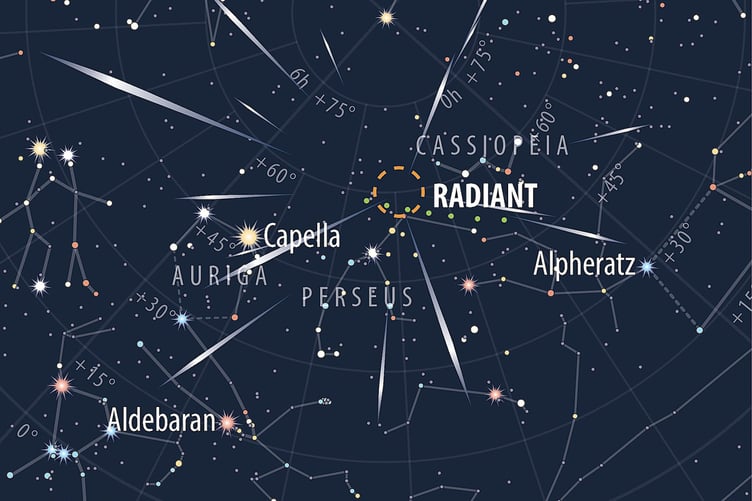
STARGAZERS will be heading for Exmoor on Wednesday (August 12) where some of the UK’s darkest skies should offer ideal conditions to see a rare celestial double-bill - the peak of the Perseid meteor shower and a deep partial solar eclipse.
Astronomers predict that about 90 to 96 per cent of the sun will be covered, making it the most substantial eclipse visible from the British Isles since 1999.
The next total eclipse will not be until September, 2090.
High points such as Dunkery Beacon will be prime spots for viewing the rare astronomical events.
The deep partial solar eclipse is expected to begin at about 6.09 pm and end at about 8.10 pm.
The meteors, also known as shooting stars, are expected to be especially well-timed for Exmoor skywatchers.
The annual meteor shower is active until August 24 but will peak overnight on August 12 to 13, with a new moon helping to create darker skies and better viewing.
Experts say an eclipse should never be looked at directly because of damage which can be caused to the retina of a person’s eye.
Exmoor National Park Authority enterprise and communications manager Dan James said: “This could not be a more wonderful opportunity to watch the Perseids, plus a chance to experience a deep solar eclipse that will never happen again in most people’s lifetime.”
Astronomers give these tips for watching shooting stars:




- Choose a dark, open location away from street lights and car headlights
- Give your eyes at least 20 minutes to adjust to the dark
- Look after midnight for the best chance of seeing meteors, weather permitting
- Bring warm clothing, a blanket, or reclining chair, and a red-light torch if needed
- Avoid using bright phone screens, which can reduce night vision
- Respect local communities, wildlife, and livestock, and leave no trace
Comments
This article has no comments yet. Be the first to leave a comment.