
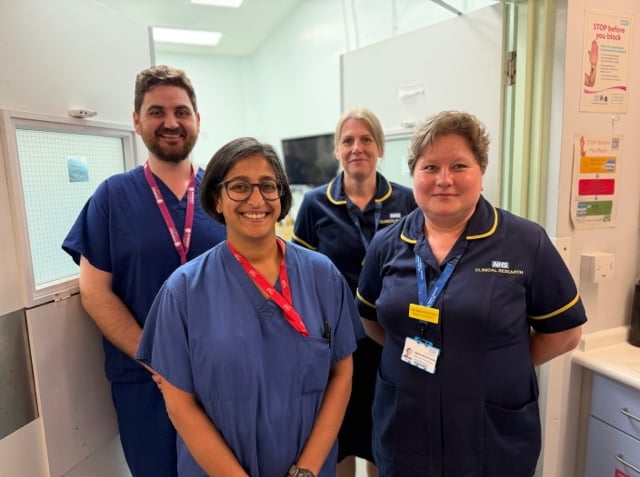
VASCULAR surgeons and nurses in Musgrove Park Hospital are teaming up as part of a new £2.5 million medical trial over the next three years.
The innovative trial aims to determine which antithrombotic medications are best at preventing complications after an angioplasty, and Somerset NHS Foundation Trust (SNFT) is one of 13 centres in the UK taking part.
Blocked leg arteries can be caused by something as common as diabetes or smoking, but can lead to amputation, or even become fatal, if not treated.
The trial has been approved under the name Clopidogrel, Aspirin and Rivaroxaban after revascularisation with angioplasty for limb-threatening peripheral arterial disease, but will be referred to as the CLARITY PAD trial.
Throughout the trial, three commonly used blood-thinner treatments will be compared, determining which combination of tablets leads to the best health post angioplasty.
Over 4,000 angioplasty procedures are carried out annually according to the CLARITY PAD trial research, with the SNFT carrying out about 300 lower-limb angioplasties per year.
An angioplasty is a procedure in which narrowed or blocked arteries are widened with a balloon or stent, with medication prescribed to patients post-operation to thin blood and prevent blood clots, and improve blood flow.
Researchers are hoping to find out which blood-thinner treatments are the best at preventing medical conditions such as heart attacks, strokes, blocked leg arteries, amputation, serious bleeding, and other health outcomes.
Patients are set to be chosen at random, by a computer, with SNFT having already recruited a number of patients.
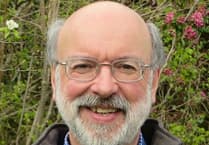
Miss Natasha Chinai, a consultant vascular surgeon at Musgrove, said: "A large amount of evidence and data have been published that suggests the mortality in five years for those with chronic limb-threatening ischaemia is 57% - the most severe form of peripheral artery disease - is second only to lung cancer with 80%.



"There are a number of interventions we can do for these patients, one of which is an angioplasty under vascular surgery.
"We put everyone with a build-up of fats, cholesterol and other substances on the artery walls onto either aspirin or clopidogrel - the latter is a preference in peripheral arterial disease.
"But when those patients undergo an angioplasty, we do not know what the best treatment regimen is for them to be on afterwards.
Musgrove Park Hospital in Taunton has already been a part of a big change this year, opening a new £87million surgical centre, The King's Building.
Miss Chinai is hoping to continue their success, saying: "We are doing really well so far in Somerset, and are consistently in the top five out of the 17 centres involved in the trial when it comes to recruitment of patients.
"We recruited our 25th patient in early April.”
The trial is aiming for 1,200 participants across 20 to 30 UK NHS hospitals, and is being funded National Institute for Health and Care Research, with sponsorship from the North Bristol NHS Trust.
So far, only 13 hospitals are taking part in the trial.
Comments
This article has no comments yet. Be the first to leave a comment.