
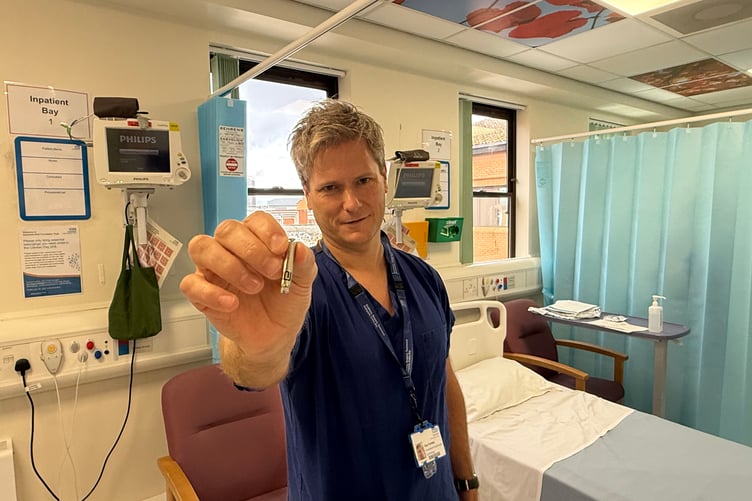
THE introduction of a leadless implant looks set to revolutionise the lives of selected pacemaker patients at Musgrove Park Hospital.
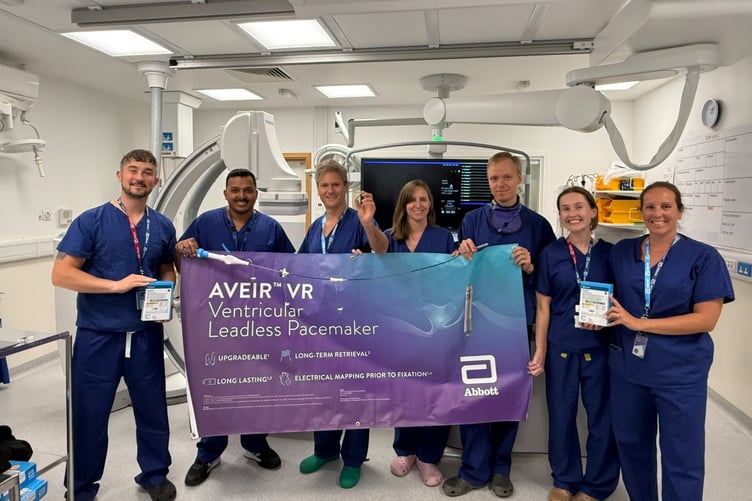
The hospital is among the first non-cardiothoracic surgical centres in the country to implant the innovative AVEIR leadless pacemaker offering pioneering technology closer to patient’s homes.
Unlike conventional pacemakers, which are implanted in the chest and connected up to the heart, the new device sits directly inside the heart and is wire-free giving patients greater freedom and fewer restrictions with a lower risk of complications compared to traditional devices.
Consultant cardiologist at Somerset NHS Foundation Trust Dr Guy Furniss says the development represents a significant step forward for carefully selected patients.
“The vast majority of pacemakers are implanted in the chest and then connected to the heart by a wire. The challenge is that these wires move every time the heart beats and, over many years, they can become a point of failure,” he explained.
“Many of our patients will have a pacemaker for decades, and traditional pacemakers also require battery replacement procedures throughout a patient's lifetime, with every intervention carrying a small risk of infection.
“Leadless pacemakers sit entirely within the heart and remove the need for these wires all together, which is one of their biggest advantages.”
While not suitable for everyone, the technology offers an important option for patients who meet specific clinical criteria - particularly younger people.
Dr Furniss continued: “A lot of patients will still be better served by a conventional pacemaker and other cardiac devices, so this is not a replacement for existing treatments.




“However, for selected patients, particularly younger people who may not require a great deal of pacing, this device can be a very attractive option. In some cases, it could potentially last for around 25 years.”
The implant procedure itself also differs from traditional pacemaker implantation, accessing the heart through a vein in the groin and steering it into place.
“With a conventional pacemaker, there are restrictions on arm movement because there is always a concern about disturbing the leads while they heal into position,” said Dr Furniss.
“With a leadless pacemaker we don't have those concerns, as patients can get up and moving much more quickly, the groin access site heals within a matter of days, and people have much greater freedom after the procedure.
“It's a really neat technique and very different to what we've done before. For patients, that's a major benefit.”
Two patients in their 40s have already had the device implanted at Musgrove, both of whom were discharged home the following day without complications.
Dr Furniss added: “Previously, we would have needed to refer these patients to larger specialist centres, so being able to offer this treatment here at Musgrove means patients can receive their care closer to home while accessing the very latest advances in pacing technology.
“We're very proud to have been selected as the first non-cardiothoracic surgical centre to implant this particular device and excited about the opportunities it brings for our patients.”
Comments
We've recently changed our login process. If you have an account for commenting, you will need to re-register on the login window.
This article has no comments yet. Be the first to leave a comment.