
WE all agree that Britain needs to invest in the production of more electrical power.
How this can be achieved is where opinion becomes divided.
No source of potential electrical power is free, because considerable sums of money are needed to provide the equipment, distribution, and maintenance.
All projects have a finite life.




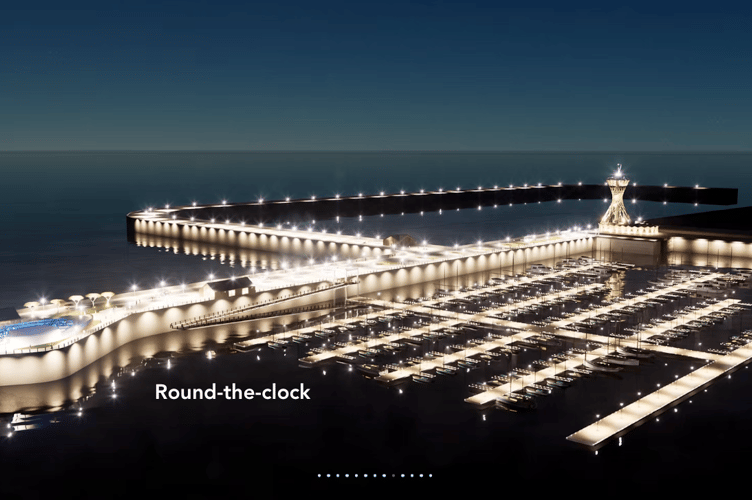
The West Somerset Lagoon (WSL) is no exception and the costs and benefits can be worked out.
The results can be compared with other ways of generating power and you can make your own comparison in terms of availability, usage in the national grid, and environmental effects.
I have done the calculation for the WSL and another hydropower source, namely run-of-river schemes.
One thousand years ago there were hundreds of run-of-river water wheels which powered mills, forges, and other machinery.
In a letter to the Gentleman’s Magazine in 1770, James Ferguson explained in detail how to design a water mill based on the speed of river flow, the flow rate, and the vertical drop the water takes before it engages with the water wheel.
Many former mill sites have fallen into disrepair but new water wheels called turbines are now providing electrical power on a small scale.
I have estimated the number of potential sites in the greater part of England, Wales, and Scotland as 2,106, which could produce 936 Mega Watts (MW, for short) continuous power, 24 hours a day with the option of reducing the power as needed.
I have checked the published estimates of the average power that may be generated by the WSL, namely about 750MW of power, a result that is reasonable.
The same conclusion was found for the output of the La Rance tidal power scheme in France.
When the cost per megawatt for several run-of-river and tidal power schemes is compared, some startling results are produced.
The La Rance scheme it is £0.4-million, Swansea Bay £4.06-million, WSL £14-million and Tellisford £4.5-million.
The La Rance scheme was so much cheaper than the others because the tidal barrage was about 0.7 km long as compared with 22 km for the WSL.
The Swansea Bay project was rejected because of its high cost.
The scheme at Tellisford on the River Frome, in Somerset, cost £135,000 with an output of 55 kilowatts, which explains its small scale, rather like the scheme on the River Brue, at Gants Mill, where the turbine and generator could be held in a dumpy bag.
Much power generation is now achieved with small scale gas and nuclear-powered turbines with an increasing amount of power from small-scale hydro, such as on the river Dart, at Totnes, in Devon.
Large-scale scheme produce much power, but at a cost of £10.9-billion such as the WSL, are very expensive.
Dr Colin Clark
• Dr Clark is a hydrologist and hydrometeorologist with more than 50 years’ experience. He has published more than 60 papers and has influenced Government policy in India and England. His plans for reducing flooding on the Somerset Moors in 2014 were raised during discussions in the House of Lords.
Comments
We've recently changed our login process. If you have an account for commenting, you will need to re-register on the login window.
This article has no comments yet. Be the first to leave a comment.