
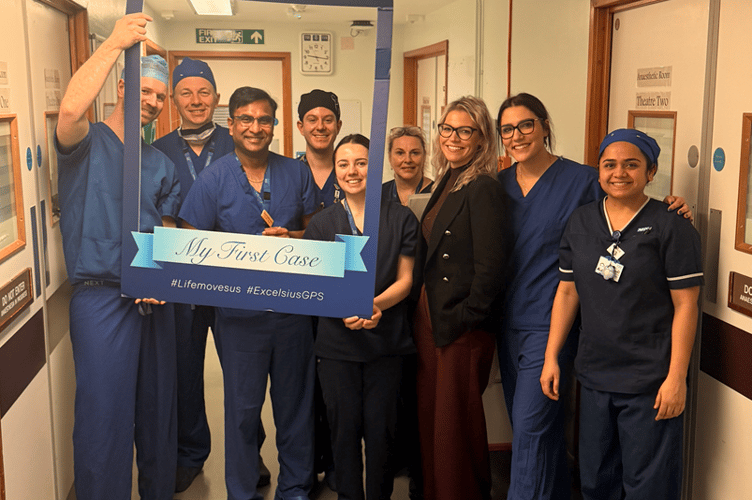
ONE of its largest ever grants has been given by the League of Friends of Musgrove Park Hospital to improve care for patients undergoing complicated spinal surgery.
It means patients in Somerset who need a spinal fusion will benefit from safer and shorter operations, thanks to the introduction of a robotic navigation system to assist surgeons.
It is the first time a system of this type has been available to spinal surgeons at the hospital and is thanks to a £835,000 donation from the league which covered the entire cost.
Musgrove, which is run by Somerset NHS Foundation Trust, has now become only the second hospital of its size, outside of large teaching hospitals, to have access to the revolutionary technology.




League president Clinton Rogers said: “A couple of years ago we donated £1.5 million to buy a state-of-the-art surgical robot which is now being used in a number of different surgical disciplines across the hospital.
“To be able now to fund a second robotic system to support cutting edge spinal surgery is a huge honour for us.
“When the surgical teams came to explain the enormous benefits to us, not just for patients but surgeons as well, it was, frankly, a no brainer.
“Our mission has always been to help provide the very best surgical care at Musgrove.”
The system works by using a navigation unit with a robotic arm to help surgeons guide and insert pedicle screws - surgical implants used in a spinal fusion to stabilise a patient’s vertebrae.
Rather like planning a journey with GPS, the system guides the robotic arm to a specific region of the patient’s spine and is up to 10 times faster than traditional surgery.
Musgrove consultant spinal surgeon Ashok Subramanian said: “We want to say a huge thank you to the league and its supporters for this very generous donation, which will benefit many patients now and in the future.”
Mr Subramanian said standard practice was to use an X-ray to view areas of the spine where an incision was needed, but the quality of images meant sometimes surgeons could not see sufficiently clearly, which meant operations took much longer while they ensured each screw went into the right place at the back of the spine.
He said: “We have only a one to two millimetre safety zone, as it is very close to the spinal cord, nerve, or blood vessels, all of which need to be avoided.
“It is therefore quite a high pressure stage of the operation, so, by using the robotic navigation system we can plan everything in advance through the computer system, so we know exactly where to make the incisions during the operation, and it is much safer, too.
“Throughout the procedure, the surgical instruments and implants are continuously displayed on the screen for the surgeon and wider theatre team to monitor, allowing the surgeon to view live feedback during the procedure.”
Mr Subramanian said it also reduced radiation exposure for surgical teams and patients because fewer X-rays were needed.
Comments
We've recently changed our login process. If you have an account for commenting, you will need to re-register on the login window.
This article has no comments yet. Be the first to leave a comment.