
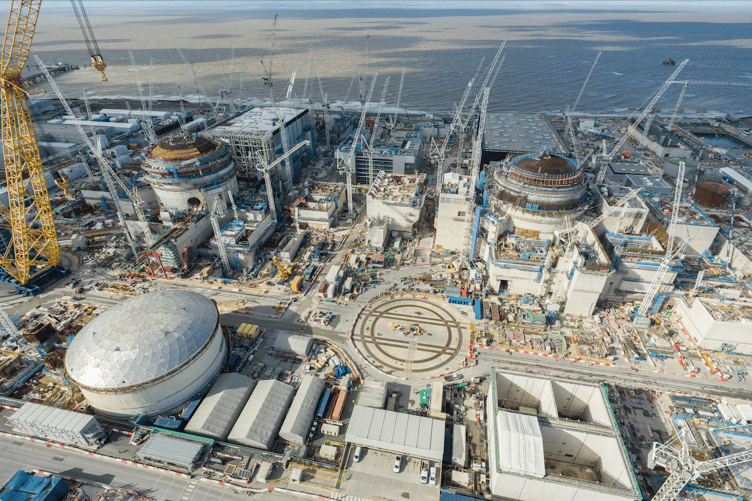
NEW images released by EDF show progress on building the Hinkley Point C nuclear power station, including completion of a 2,000 feet long fish return tunnel.
Work has just finished on digging the tunnel for the power station’s fish return system, which runs under the Bristol Channel.
The tunnel boring machine has dug its way through the seabed five months after setting off from dry land and has now been retrieved by a floating crane.
The machine will now be taken away to be cleaned and used on another site.
The fish return system is one of three fish protection systems which will give the Hinkley C station more fish protection than any other power station in the world.
The other measures are an acoustic fish deterrent and four low speed water intakes, designed so that fish can swim away from as close as 6.5 feet in the 12.5-mile wide channel.
The tunnel boring machine was named ‘Sarah Guppy’ by local school children, after the pioneering 19th century woman engineer from Bristol.
 Nuclear milestone marked as Hinkley Point B joins A station for decommissioning
 Nephew to a Pope, known around the world, sculptor Tad Mandziej dies at age of 84
 Appeal for witnesses after double-fatal road crash closes A358
- Large emergency services response including air ambulance for A358 serious crash
Guppy, who died in 1852, was the first woman to patent a new mode of making bridges and also patented a forerunner of the humble toaster.
The Hinkley C seabed breakthrough completed five miles of marine tunnels for the nuclear site project.
The latest images to be released show how the power station is progressing into its fit-out phase, with both of its nuclear reactors installed and work underway to install the world’s largest turbine.
EDF Energy’s latest forecast is for the first Hinkley C reactor to start generating power in 2030, which will be 13 years after construction started, with the second reactor coming online a year later.
Project costs have nearly doubled from £18 billion when the station was approved to the latest £35 billion estimate.
Comments
We've recently changed our login process. If you have an account for commenting, you will need to re-register on the login window.
This article has no comments yet. Be the first to leave a comment.