
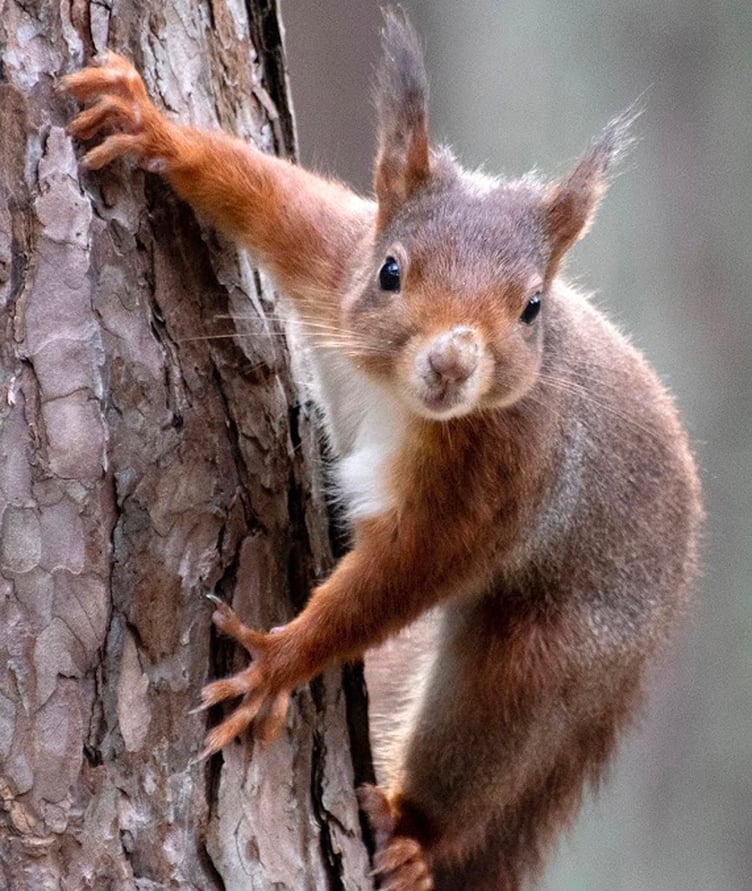
THE team working on reintroducing red squirrels to Exmoor is collaborating with a project which last year released pine martens into the national park
Red Squirrel South West (RSSW), based in Ottery St Mary, is using a £20 million Government grant to return the UK native red squirrel to a 35-mile woodland corridor along the Exmoor coast between Minehead and Ilfracombe.
But, it has to ensure most of the invasive grey squirrel population is killed off to allow the reds to survive.
Now, organisers are working with the Two Moors Pine Marten Project (TMPMP), which is supporting grey squirrel management training on Exmoor.
TMPMP released nine pine martens last September which have already started producing young and needs to see grey squirrels controlled to allow the new species to thrive.
A RSSW spokesperson said: “Pine martens are now being seen in more parts of the South West, following successful reintroductions.
“Their return is very encouraging news for nature conservation, but it also means that grey squirrel management needs to be undertaken with care.
“Sponsored training courses will focus on best practice grey squirrel control in areas where pine martens are present, including the effective use of live trapping.
“We no longer recommend the use of kill traps in areas where pine martens may be present.
“Live trapping provides an effective alternative, and our training aims to ensure grey squirrel control is carried out legally, safely, humanely, and efficiently.

.png?trim=0,0,3,0&width=752&height=628&crop=752:628)
“Our work is about more than managing grey squirrels, it is about protecting and restoring healthy woodlands across the South West.
“By reducing the damage caused by greys, we are laying the foundations for stronger, more resilient landscapes, and keeping the door open for the day when red squirrels can return here.
“Red squirrels have declined dramatically across Britain, with competition from grey squirrels, squirrelpox, and habitat loss all contributing to their decline.”
The spokesperson said although red squirrels were now extinct in the mainland Westcountry the region had significant potential for their future recovery.
They said: “Protecting suitable woodland and reducing grey squirrel numbers are important parts of creating the conditions in which red squirrels can thrive again. “
The spokesperson said a bumper crop of beechnuts had been experienced this autumn across many parts of the Westcountry which grey squirrels were making the most of.
They said: “An abundant autumn food supply not only improves grey squirrels’ chances of surviving the winter, but can also support mid-winter breeding.
“In the past, prolonged cold winters would have limited this, but our increasingly mild winters mean grey squirrels in the South West can now potentially produce three litters a year.
“For those carrying out grey squirrel control, plentiful natural food can also make management more challenging, as squirrels have less incentive to visit bait stations and traps when there is plenty of food available naturally.
“It is another reminder that grey squirrel management needs to be consistent and long-term.
“Food availability will always fluctuate, but keeping squirrel numbers under control can help reduce the pressure they place on our woodlands.”
Comments
We've recently changed our login process. If you have an account for commenting, you will need to re-register on the login window.
This article has no comments yet. Be the first to leave a comment.