
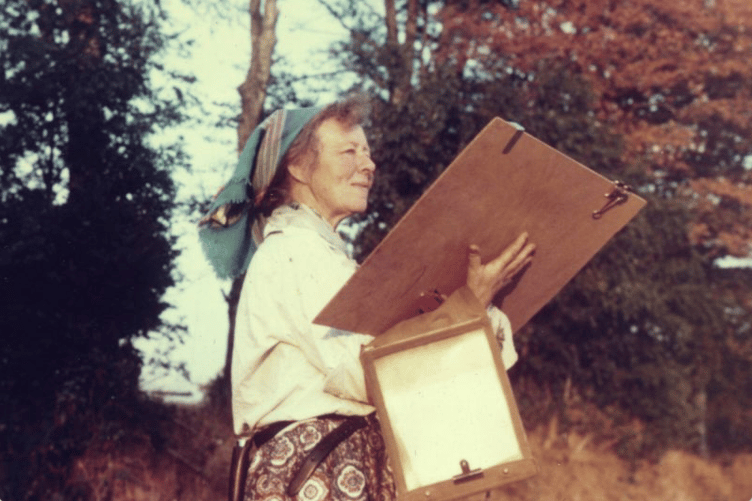
THE life and work of iconic Exmoor nature writer Hope Bourne, who was a ‘legend’ for more than 60 years, will be revealed in the first biography of her, due to be published on November 2.
Known as the ‘Lady of Exmoor’, Hope died in 2010 aged 91 years after being largely forgotten.
Now, ‘A Life Outside - Hope Bourne on Exmoor’, written by Sara Hudston and published by the Exmoor Society, spotlights her extraordinary life, spent largely alone on the moor, and her achievements as a writer and conservationist.
The book includes many of Hope’s exquisite pencil drawings, and a selection of extracts from the 1,000-word columns she wrote for the Free Press in the 1970s and 80s, delivering the pencil-written manuscript, often on the backs of envelopes, in person, every week.
These have never been republished.
Ms Hudston said: “Her extraordinary life and jewel-like art often grab the most attention, but it is her writing that truly sets her apart.
“Her columns for the local paper are among the best of her work and it is really exciting to bring them to light again.”
The book will later be officially launched during the Dulverton and Exmoor Literary Festival on November 13.
 Thousands of customers at risk after leading estate agency partner data breach
 Drought means Exmoor's giant Wimbeball Lake could see water level hit new record low
 Court battle goes on as housing association seeks possession of Exmoor woman's home
  Exmoor neighbours await news of whereabouts of explorer Sir Ranulph Fiennes
To mark the occasion, the society is staging a free exhibition of Hope’s original artwork in Dulverton Parish Rooms from November 2 to 15, from 10 am to 3 pm daily.
Fiercely self-reliant, Hope lived alone in a series of remote and ramshackle cottages and caravans on Exmoor without electricity or mains water.
She survived by growing vegetables, fishing, shooting for the pot, and reusing and recycling things that others threw away.
Hope spent 20 years in a caravan outside Withypool, getting up at 5 am and, in her younger days, walking 20 miles across the moor with her sketch pad.
Writing provided her with a small, but precarious, income and her unconventional outdoor life gave her freedom to write, draw, and paint.
Her remarkable ecological awareness, rejection of materialism, and close relationship with the natural world were decades ahead of their time.
In 1972, she wrote the UK’s first impassioned plea for rewilding, a vision that encompassed people as well as wildlife.
Hope Bourne was born in Oxfordshire but moved to Hartland, in Devon, at the age of nine, when her mother became headmistress of the village school.
.jpeg?trim=0,0,3,0&width=752&height=1123&crop=752:1123)
After her mother’s death, Hope chose a solitary life and spent the next 60 years recording the Exmoor landscape, wildlife, history, and changing rural traditions.
Hope died just a few days before her 92nd birthday, leaving her estate to the Exmoor Society, of which she was a longstanding member.
She had five books published about Exmoor and in old age became a nationally-known figure through a number of television documentaries.
The Exmoor Society celebrated the centenary of Hope’s birth in 2018 by publishing a short anthology of her lesser-known writings.
A spokesperson said: “Hope’s life and work is now being rediscovered by a new generation of readers who are becoming increasingly enthralled by her writing and ideas.”
Comments
We've recently changed our login process. If you have an account for commenting, you will need to re-register on the login window.
This article has no comments yet. Be the first to leave a comment.