

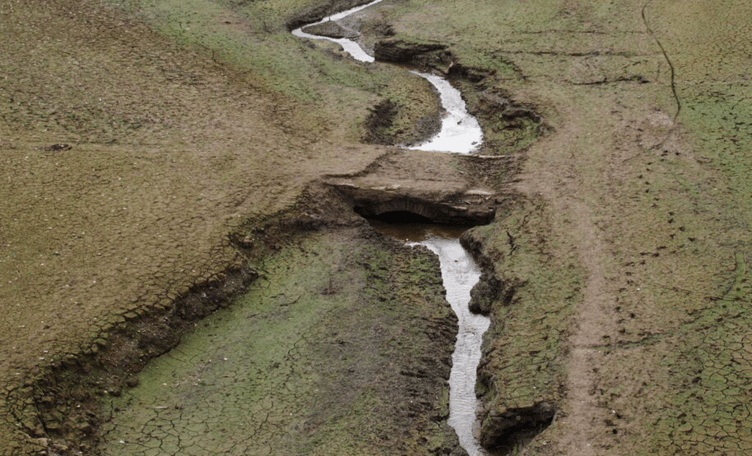
Bessom Bridge, which disappeared beneath the water when Wimbleball reservoir was constructed nearly 50 years ago, is now clearly visible as water levels continue to fall following one of the driest summers in recent years.
It comes as an emergency drought permit has been issued by the Environment Agency to help manage water supplies.
The remarkable sight has become a stark illustration of the water shortage affecting the region.
Latest figures show Wimbleball, one of the region’s three strategically important reservoirs, was only 18 per cent full on October 4, compared with 30 per cent at the same time last year.
The reservoir, which can hold more than 21 billion litres of water, helps supply approximately 390,000 people.
Bessom Bridge, which once carried traffic across the valley before it was flooded to create the reservoir, is normally hidden beneath the water.
Its reappearance comes as Wimbleball approaches the record low level of 17.2 per cent recorded during the drought of October, 2022.
The Free Press reported last week that the reservoir had fallen to 21 per cent of capacity by September 27, despite recent rainfall.
Now, the EA has confirmed it granted SWW a drought permit on October 2 following an urgent application from the company.
The permit allows SWW temporarily to suspend the normal flow of water released into the River Haddeo, provided an equivalent volume is released further downstream to support water abstraction from the River Exe.
 Parish councillors preparing strategy to fight future bug infestations in Blue Anchor
 Drought means Exmoor's giant Wimbeball Lake could see water level hit new record low
 White-tailed eagles making Exmoor their new home but still have to be fed by humans
 Bids for original Minehead coast path signpost will help boost Exmoor heritage
The arrangement is intended to conserve precious supplies at Wimbleball while protecting river habitats and wildlife.
SWW originally applied for the permit on September 16 but, as conditions worsened, requested urgent consideration on October 1, removing the requirement for a public examination of objections.
The permit will remain in force until February 28 next year unless withdrawn earlier. However, the EA has warned that the measure alone will not be sufficient to secure supplies.
SWW has also applied to the Government for a ban on non-essential water use by some businesses across Mid Devon and parts of East Devon and Dorset.
Joanne Laeger, the EA’s area drought manager, said: “Drought has not gone away with the arrival of autumn and the rain that would normally accompany the change in season.
“Steps must be taken to secure public water supply and we are keeping a close eye on the environment, ready to respond to signs of impact and distress.
“The goal is to get the most out of our water supplies and that means being extra careful in how we use it. This applies to everyone.”
The EA said the coming winter would be critical to restoring water resources across the South West.
Above-average rainfall could allow the region to begin recovering from drought by April, 2027, but officials warned that water shortages could persist into next spring and summer.
Comments
We've recently changed our login process. If you have an account for commenting, you will need to re-register on the login window.
This article has no comments yet. Be the first to leave a comment.