
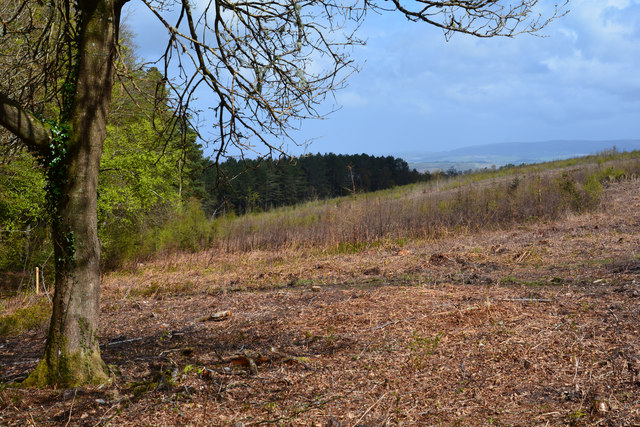
CONCERN has been raised over another large-scale Forestry England tree felling operation on Exmoor.
The Free Press reported recently on a Forestry England felling project on Wootton Ridge, near Wootton Courtenay, and also on plans to fell several thousand trees near Roadwater.
Now, parish councillors have questioned work underway in the Oway plantation, located in the triangle of land between Timberscombe, Dunster, and Wootton Courtenay.
Timberscombe councillors asked Exmoor National Park Authority (ENPA) if it could explain what was happening in the plantation, which was developed in the late 19th century.
 Starlight spectacular beats the rain as Dulverton sparkles for annual festival
 Emergency services on scene of Exmoor crash with Stork Bram winds making A39 'unsafe'
 Medieval re-enactors and torchlight procession light up Dunster for winter festival
 Batten down hatches as Storm Bram brings heavy rain and strong winds
They were told the work was phase one of a plan for contractors Euroforest to clear 51 acres over the next eight years.
Parish council chairman Katherine Attwater said councillors were working with ENPA to improve the way Forestry England gave notice to local farmers and the public of the work it had planned, and to also advise on the environmental benefits of what it was doing.
ENPA head of conservation Graeme McVittie said: “The precise timing of future phases will depend on the relative value of timber at the time.
“All the felled areas will be replanted, this is a legal condition placed on Forestry England by the regulatory arm of the Forestry Commission.
“There will be areas retained for longer term retention or subject to thinning or selective felling.
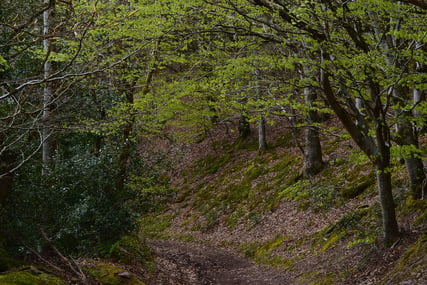
“Most areas will be planted with a mixture of evergreen conifers including Douglas fir, sitka spruce, western hemlock, noble fir, and Scots pine.
“Some smaller areas will be replanted with a mix of broadleaves.
“Overall, about 10 per cent of the area will be left unplanted as open ground.”
Mr McVittie said the work was part of a 10-year plan by Forestry England for the Exmoor Forest Estate, covering the period from 2021 to 2031.
He said: “The plan follows the process and format for all similar plans for the public forest estate throughout the country.
“It complies with current guidelines as laid out in the UK Forest Strategy.
“The contractors will be under an obligation to follow strict environmental conditions to avoid pollution, wildlife impacts, and damage to any archaeology or other infrastructure.”
Mr McVittie said the plan had been approved by the Forestry Commission in the same way as necessary for any forestry activity and it followed all current national guidelines and standards of good practice.
He said: “Productive woods and forests have been part of the landscape for many decades, and we recognise the need for a sustainable domestic supply of timber for many different needs.
“Managed forests sequester carbon, provide good wildlife habits, create spaces for recreation, provide jobs and services, and support the local economy.
“The current forest plan recognises the benefits of low impact silvicultural systems, and we fully support this.
“We prefer to see a move away from larger, regular shaped clear-fells to smaller, irregular units restocked or regenerated with a variety of species such that over time the forest develops a more irregular varied structure, but we do understand that this is not always possible.”
Comments
This article has no comments yet. Be the first to leave a comment.