

EXMOOR National Park Authority has declared a climate emergency and agreed to work towards being carbon neutral by 2030, subject to a detailed action plan now being drawn up.
The report to members noted the 30 per cent reduction in carbon emissions that the Exmoor authority had already made since it started monitoring its carbon footprint across all its corporate assets in 2008.
Measures taken include action to improve energy efficiency within authority owned buildings and install renewable energy along with a scheme to facilitate installation of 73 new renewable energy systems in local communities, farms and houses across Exmoor.
 Government should give Westcountry 'fair share' of funding says Exmoor campaigner
 Starlight spectacular beats the rain as Dulverton sparkles for annual festival
 Emergency services on scene of Exmoor crash with Stork Bram winds making A39 'unsafe'
 Batten down hatches as Storm Bram brings heavy rain and strong winds
The authority has also taken steps to respond through management of its own estate, particularly the woodlands which are managed in-house, and collaboration with other foresters and landowners to support positive woodland planting and management.
Trees play a vital role in combating climate change by absorbing carbon dioxide and improving habitat connectivity and biodiversity while helping to reduce soil erosion and flood risk.
There are estimated to be in excess of four million tonnes of carbon dioxide stored in Exmoor’s existing woodlands, plus another million tonnes in hedgerow and free-standing trees, according to a 2013 study commissioned by the park authority.
Active management of woodlands through the felling of carefully selected trees improves resilience towards tree diseases and climate change, while also improving the habitat for a variety of woodland species such as birds, butterflies and fungi.
Using more of the timber in the national park to produce furniture, flooring, doors, windows and even buildings as well as signs, styles and gates, helps lock away a further 26,000 tonnes of carbon dioxide a year.
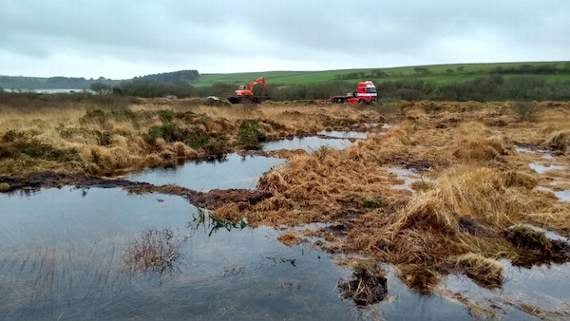
Nearly 2,500 hectares of peatland in the national park have so far been restored through the Exmoor Mires Partnership, with plans to extend this to at least 3,000 hectares.
Peatlands are the UK’s single most important terrestrial carbon store, containing 20 times more carbon than all UK forests.
As the planning authority for the area, significant further steps to address climate change are included in Exmoor National Park Authority’s Local Plan.
For the full report, buy tomorrow’s Free Press.
Comments
This article has no comments yet. Be the first to leave a comment.