
IT’S not an Easter baby bunny - but Exmoor Zoo has delivered a baby wallaby just in time for holiday visitors to see.
Visitors can catch glimpses of the joey, as wallaby babies are called, in its mother’s pouch while it grows big enough to step, or hop, outside.
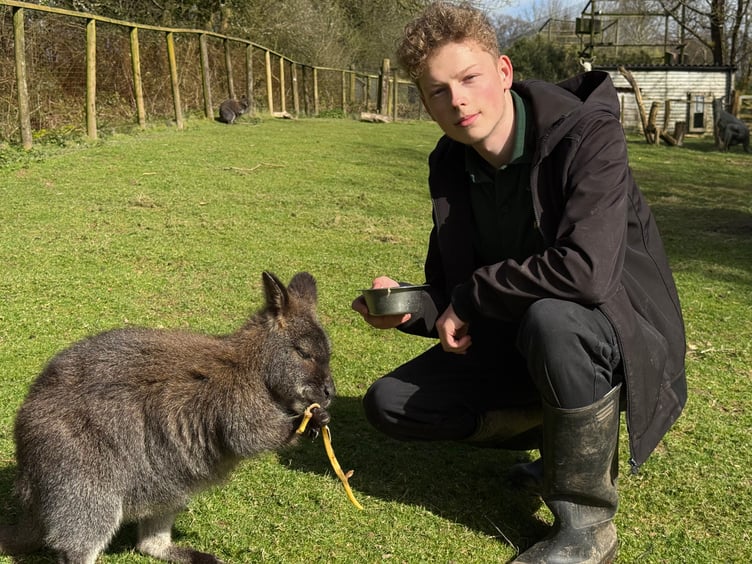
Trainee keeper Riley Kesterton has been caring for the wallabies since he started work at the zoo in September.
Riley said: “Spotting the joeys is great, we have one which is further along in age as it has more fur on its head, and one that is pinkie brown, so it is a bit younger than the other one.
 Park authority wants to show businesses how to benefit from wildlife and nature
 Exmoor's Dunkery Beacon rated best place in England to see meteor shower this month
 Charity completes massive salt marsh restoration project on West Somerset coast
 Online petition calls on councils to save trees and 1,000-year-old lane in Minehead

“At this stage just the head is likely to be seen as they start to grow bigger until eventually they are afoot - a term described by keepers when they will not stay in the pouch but occasionally put their head in for milk.
“It can get quite hot in those pouches, so, from time to time, keepers see tails and feet also sticking out to cool down.
“Like most marsupials, they are dependant on the milk mum produces for up to a year, but as they get older and venture out the pouch they start to eat more solids and drink less milk.
“Hopefully, the older joey will hop out ready for our visitors to see them.”
Zoo co-partner Danny Reynolds said: “We have had our first joey pop its head out the pouch ready for spring.
“Our red necked wallabies, also known as Bennett’s wallabies, have a very short gestation period of around 28 to 30 days.
“The tiny bean-size joey will then disappear into the pouch for up to nine months as it grows.”
In the meantime, Riley is excited to be a ‘Jill’ for the first time, the name for a wallaby mum.
Exmoor Zoo, which started in 1993, attracts more than 45,000 visitors each year who are educated by the 14-plus staff, a curator, and education team on the importance of looking after the environment and respect for the habitat of native and exotic animals.
It has more than 35 breeding programs to maintain its captive population of endangered species as a member of the British and Irish Association of Zoos and Aquariums and the European Association of Zoos and Aquaria.
The zoo co-operates in national and international breeding programmes for many of the world’s rarest birds and animals, and has been particularly successful with its wetland birds.
Comments
We've recently changed our login process. If you have an account for commenting, you will need to re-register on the login window.
This article has no comments yet. Be the first to leave a comment.