
ONCE Dunster’s haven harbour had been second only to Bridgewater as Somerset’s biggest and busiest port. But by the 16th century things were changing.
For instance, from 1558, when Minehead’s townspeople were granted a charter to enable them to control the port of Minehead, they charged weirage duties for vessels going to Dunster Haven, much to the disgust of the then resident of Dunster Castle.
From this time on, the trade in and out of Dunster diminished - even in 1559, Dunster was described as “not fytt nor mete to charge nor discharge” in a survey prepared for the Exchequer regarding landing places in Somerset other than Minehead or Bridgwater.
Dunster Haven, Watchet and Porlock Bay were listed as ‘sub’ ports of Bridgwater in 1565 - the three together were described as importing salt, wine, victuals, wood and coal in small boats.
 Minehead's Beach Wellness Gym marks 10 years of helping patients stay fit and healthy
 Minehead youth facing two rape and sexual assault allegations
 Arrest warrant for ex-taxi driver after non-show on rape and sex offences charges
 Arrest sought of man who urinated in Minehead church Holy water and damaged cross
A year later the Mychael of ‘Donstare’ carried 200 stones of wool exported from Milford in Wales. The Luttrells, accepting that Dunster Haven was no longer viable as a port due to silting up, built a new quay and harbour at Minehead which was completed in 1616.
It replaced the old Minehead harbour which was also becoming blocked up with pebbles, and which the residents of the town could not afford to maintain. The end result was that Minehead lost its charter and the Luttrells regained control.
Dunster Haven continued to function as a small harbour probably for another 150 years or so. In 1633, it was rather disparagingly described as ‘pretty’ and being often visited by shipping going to and from Ireland.
Other vessels, such as the Gift of Swansea, paid keelage to Minehead in the 1640s, whilst on route to Dunster. However, by the late 1700s no vessels of note were going there.
It is not known when the river mouth became totally choked with sand, pebbles and vegetation but the Hawn was described, as the ‘Hone,’ in the 19th century.
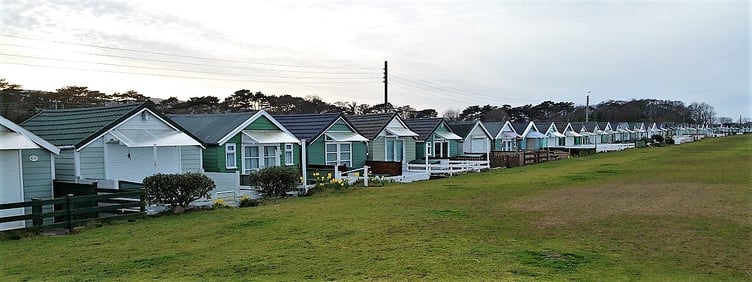
Few visited Dunster Haven, the beach and Hawn having been left in their natural states for more than 100 years and most visitors, as now, explored the castle and medieval village. However, following the successful introduction of bathing huts at Minehead and Blue Anchor early in the 20th century and the progression to chalets, in which one could stay overnight, at Blue Anchor a few years later, Alexander Luttrell decided to develop beach chalets at Dunster Beach as a commercial enterprise.
The first one was erected in 1927, and screened by trees, therefore well out of view of the residents of the castle. It was also painted green to blend in with the environment. The hut still exists today and is chalet number 17.
More huts were constructed, initially being mere shells with no internal features. Owners were able to adapt their chalets to meet their own needs, adding partitions and shelving, for instance. Toilet blocks with flush lavatories were provided and eventually electricity too.
At the beginning of World War Two the chalets at Dunster housed evacuees and later the Army requisitioned them, removing all internal fixtures and fittings, which were stored in Minehead.
Dunster Beach became Dunster Camp and the chalets were used to house soldiers of the Royal Engineers and the Somerset Light Infantry while they built sea defences.
Tangible evidence of some of these - pill boxes - remain on the beach and its environs. Other Army units came and went as the war progressed.
The beach was returned to Geoffrey Luttrell, Alexander’s son, in 1946 and the chalets returned to their owners, albeit in a somewhat sorry state. The holiday camp was sold in 1951 to Herbert Kempton Reeves, who attempted to ‘improve’ the Hawn and provide access to the sea for small boats. The costs proved prohibitive and Mr Reeves’ dream did not come to fruition. He also searched for evidence of a medieval landing stage or quay to no avail. On a positive note more huts were built and services, such as the provision of shops, improved.
In 1965 the owners of the chalets formed a company called Dunster Beach Holidays Ltd. and purchased the foreshore and beach as well as all the chalets and other buildings and machinery.
They have also tried to purchase the Hawn, which is Crown land and leased, but had not succeeded by 1995. There is public access to the beach and the Hawn.
There are now 265 chalets at Dunster Beach, all painted green, albeit in different shades. There are good views from the beach across to Wales and around Blue Anchor Bay. The heritage West Somerset Railway has a station on Dunster Marsh and there is also, of course, the Hawn, which is now a tranquil haven for nature and the perfect place for a gentle stroll.
Comments
This article has no comments yet. Be the first to leave a comment.