
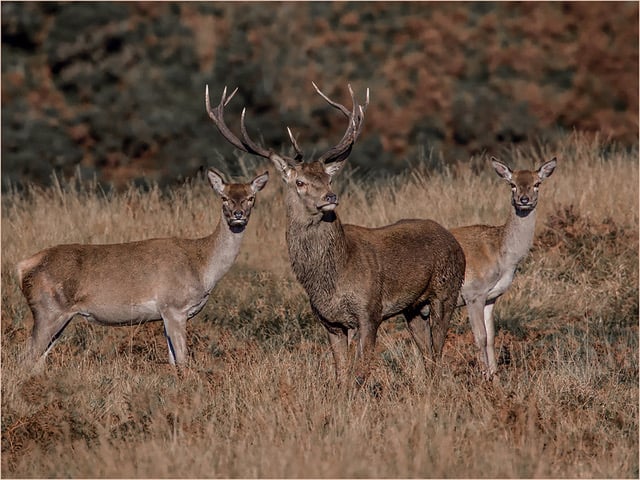
‘PROFOUND changes’ to the way deer on Exmoor are managed could result from a new Government policy statement.
The Exmoor Society said the Department for Environment, Food and Rural Affairs (Defra) had set out a series of actions over the next 10 years.
A society spokesperson said it was a response to the pressure that a ‘massive increase’ in the wild deer population was putting on the landscape, and on woodland regeneration in particular.
The spokesperson said recent evidence showed about one-third of English woodlands were now negatively affected by deer browsing and trampling, up from about a quarter in the early 2000s.

.jpeg?width=209&height=140&crop=209:145,smart&quality=75)
.jpeg?width=209&height=140&crop=209:145,smart&quality=75)
Defra’s policy statement suggested a wide range of actions, including supporting landowners and tenants with grants, boosting the domestic wild venison market, and changing the existing approach to licensing.
The Department was considering a ‘more flexible approach’ which could include extending the season under certain circumstances and issuing night shooting licences.
The spokesperson said both public safety and animal welfare were emphasised in the statement, although night shooting could be dangerous and encourage poaching if it was not carefully managed.
A key aspect of the plan was the need for regional and landscape-scale approaches.
The spokesperson said the challenges of managing red deer on Exmoor would be very different to the challenges of managing fallow deer in South East England.
They said: “What the approach for Exmoor looks like remains to be seen, and we will ensure that we keep members and supporters updated with any developments.”
The spokesperson said the society, like many others, was also ‘deeply concerned’ by a recent Defra decision to withdraw the proposed species-rich grassland option (GRH6) from its ‘sustainable farming incentive’, which was due to reopen in June.
The option offered a significant financial incentive for farmers and landowners to protect and restore species-rich grasslands, one of the UK’s most fragile and biodiverse habitats.
Across Exmoor, many farmers had already started adapting their grassland management to access the funding.
But, Defra cited low initial uptake as the reason for removing the option.
The spokesperson said: “However, along with others, we have highlighted that this reflects the rarity and fragmented nature of species-rich grasslands, as well as the administrative barriers involved.
“In particular, eligibility required prior classification as ‘priority habitat’ by Natural England, a process that is both time-consuming and resource-intensive.
“We have raised concerns to Defra that removing GRH6 will undermine efforts to safeguard and restore these vital habitats.
“Without accessible support, there is a real risk that remaining species-rich grasslands could be lost or further degraded.
“While Defra has indicated that similar support may exist under ‘higher tier stewardship’, this route is significantly more complex and far less accessible to many farmers.”
The society has also been working with Plastic Free Exmoor and Exmoor National Park Authority to address the issue of plastic tree guards.
The spokesperson said: “While these guards play an essential role in protecting young trees from browsing animals, they can end up littering our landscape if not removed.”
Comments
We've recently changed our login process. If you have an account for commenting, you will need to re-register on the login window.
This article has no comments yet. Be the first to leave a comment.