
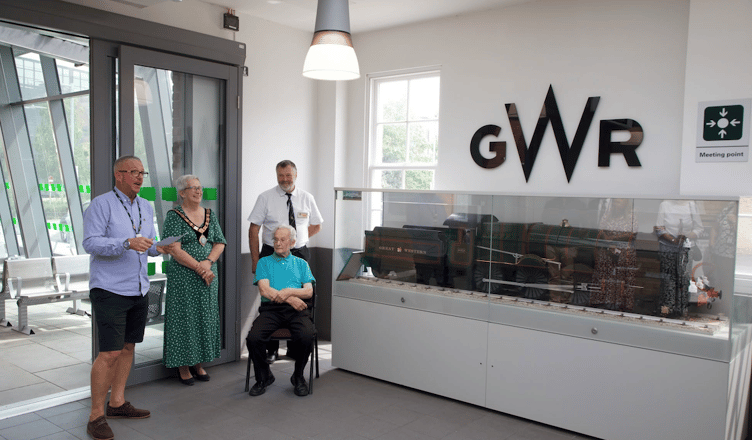
WEST Somerset Railway Association (WSRA) volunteer and keen horticulturalist Clive Goddard, aged 92, was guest of honour for an event which celebrated a lifetime of railway service.
Mr Goddard was asked to open a new sensory floral area at Taunton Station, where he first started work for the then-British Rail in 1949.
He had established and maintained flower beds at Taunton Station and continued to look after them despite his retirement
Mr Goddard was also a leading light for many years in work to ensure Bishops Lydeard Station on the West Somerset Railway had attractive flower displays to welcome passengers arriving on the platforms, for which Britain in Bloom awards were won.
The new Taunton floral area on a large part of a former bay platform area next to platform five has been designed to offer a sensory experience.
It contains a variety of plants to support insect life, and also offers seating for passengers to have the opportunity to relax.
A surprise element of the day for Mr Goddard was when he was also asked to unveil a former nameplate carried by a Class 43 power car.
When the modern day Great Western Railway (GWR) bade goodbye to its HST trains it retained some with a reduced number of carriages in the formation and dubbed them the ‘Castle’ class.
 Minehead to lose its Brewer's Fayre in fallout from Government's last Budget
 Councillors told weak planning enforcement is damaging their reputation
  Large investment going into refreshing prominent Minehead public house
 Blown high voltage fuse leaves nearly 70 West Somerset properties without electricity
One of the power cars was named ‘Taunton Castle’, and to his surprise Mr Goddard was asked to unveil one of the nameplates which was mounted in the booking office following the withdrawal of the power car.
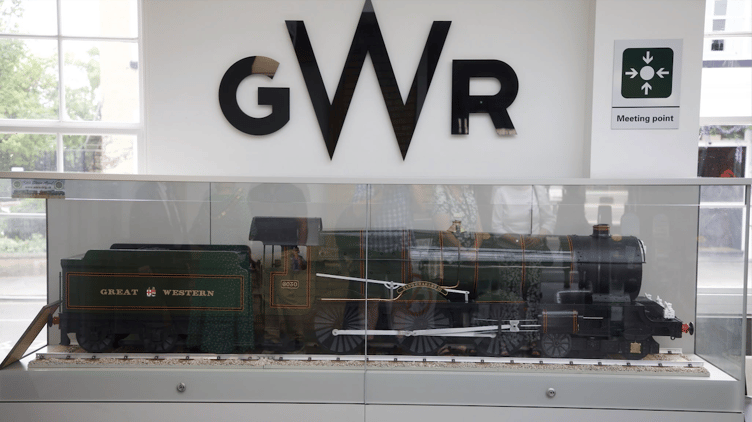
Also in the station’s entrance hall and booking office area stood a large scale model locomotive made by Mr Goddard after his retirement from recycled materials, including aluminium signs which were part of the central platform’s flower beds.
In anticipation of Prince Charles succeeding to the throne, Mr Goddard named the model ‘King Charles III’ and gave it the number 6030 - the last of the ‘King’ class was 6029, originally named ‘King Stephen’ and later ‘King Edward VIII’.
Mr Goddard had started work in the telegraph office a year after nationalisation of the railways and the forming of British Rail and is believed to be the last living member of the station staff from that era.
When he began his career, little had changed from pre-nationalisation years and the heaviest of the express trains passing by him were headed by members of the ‘King’ Class 4-6-0s.
Three years after his railway service started, the express steam locomotive 7036 ‘Taunton Castle’ emerged as a new build from Swindon Works.
The penultimate member of its class, it had a short working life as the onset of ‘dieselisation’ led to its withdrawal in 1963.
Guests who attended the floral area opening and nameplate unveiling were then provided with light refreshments in the nearby Great Western Hotel.
Thanks were expressed to Paul Finnimore and Joe Graham, of GWR, for making the special afternoon possible for Mr Godard, and to Newton Replicas, of Derby, which refurbished the nameplate.
Comments
This article has no comments yet. Be the first to leave a comment.