
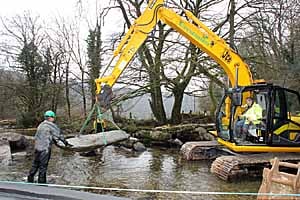
THE first stone is pictured being winched into place as work began this week to rebuild one of Exmoor's most iconic landmarks - Tarr Steps bridge.
The ancient 'clapper' bridge, believed to be of medieval origin, was all but washed away in the floods that devastated the area just days before Christmas last year.
But repairs to the 50-metre grade one listed structure, which is a scheduled ancient monument and links Dulverton and Withypool, are expected to be completed by early next week.
The force of the swollen River Barle sent the majority of the giant stones that make up the bridge crashing downstream.


-at-Holnicote-Estate-Somerset-National-Trust-Images-Nick-Upton.jpeg?width=209&height=140&crop=209:145,smart&quality=75)
Luckily, although each is unique, they were numbered following previous floods in the 1940s, 50s and 70s.
But engineers have still faced a logistical challenge to put the bridge back together.
Somerset County Council, which is responsible for the structure because it is a public highway, has been working with contractors Crestmoor to retrieve the stones.
County councillor for Dulverton and Exmoor Frances Nicholson said she was delighted that work was now underway to restore Tarr Steps to its former glory.
"The bridge is an enduring and iconic feature of the Exmoor landscape that has been in use since medieval times," she said.
"It is very much a honeypot for visitors to Exmoor and a major contributor to the local economy, drawing in people from all over the country to come and stay in the area."
And Cllr Nicholson revealed that although the cost of rebuilding the seven displaced spans was about £10,000, that was a snip compared to the bill for building a modern bridge - around £500,000.
"As an ancient monument the bridge must be put back exactly the way it was so it is especially pleasing to see how the ancient design lends itself to quick and economical repair," she said.
The repairs will include the replacement of an upstream 'tree protection boom' made of steel wires which was also torn out in the floods.
The loss of this meant that damage to the bridge was further compounded by the force of large trees that came down in the bad weather and floated downstream.
Photo: Steve Guscott
Comments
This article has no comments yet. Be the first to leave a comment.