
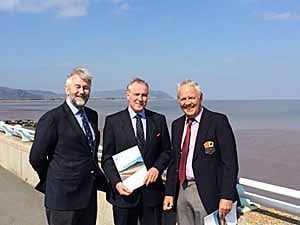
HUGELY ambitious plans for a tidal energy and regeneration boosting lagoon stretching from Minehead to West Quantoxhead were unveiled this week. The project, estimated to cost a massive £2.4 billion and being driven by a consortium of local businessmen, is aimed at harnessing the power of the Bristol Channel, which has the second highest tidal rise and fall in the world. In addition to producing electricity for an estimated 500,000 homes, the scheme from LongBay SeaPower would include a marina for at least 200 boats with future potential for up to 600 vessels of all sizes. A ferry terminal linking West Somerset and North Devon to South Wales would also be constructed, alongside a dock for berthing mid-sized cruise ships and expedition vessels. The development would provide unlimited access to the Bristol Channel via sea locks with more than 50 square kilometres of permanent protected water for a host of boating and tourist-based activities, from sailing to surfing. There would also be new infrastructure for marina-related services and a possible upgrading of facilities for Minehead's RNLI and other emergency services. The top of the lagoon wall, in which nine-metre turbines would be installed, would become a thoroughfare for pedestrians and cyclists and include a tram-like system providing transport from Doniford to Minehead. And the project could also help protect the West Somerset coast from coastal erosion and flooding. However, the scheme is still only a concept and will take an estimated £1.6 million to bring to a stage where it could be considered 'planning ready'. But John Clyde-Smith, chief executive of LongBay SeaPower, described it as "very exciting". "The project is being driven by local people who not only have extensive local knowledge of the area but a fundamental love of it," he said. "It is, therefore, not just about the production of renewable energy but is a regeneration project of the like the area has not seen." The company went public with its plans for the first time at a special conference on tidal power hosted by West Somerset Council in Williton on Wednesday. The event, the first of its kind to be held in the region, brought together big city and small rural authorities, as well as environmental experts, commercial companies and the Local Enterprise Partnership. Mr Clyde-Smith told the delegates that his company's scheme would use the power of the impounded water to generate electricity to a scale not yet seen in the field of tidal range energy. And he said it would go a long way to achieving the Government's renewable energy targets. The unveiling of the scheme was also the launch of a public consultation and LongBay SeaPower says it wants to hear the views of local authorities, residents and businesses via the company's website, Facebook or future forums. "Tidal energy and indeed construction technology is constantly improving, enabling the scheme to evolve," said Mr Clyde-Smith. "The lagoon will be improving our environment for generations and therefore the consultations will be used to create the final design to develop, regenerate and leave a legacy of which we can be proud." Private investment is expected to finance the major cost of the project, although the company is also seeking public grant aid to allow it to move forward with feasibility research, planning, development and design. Detailed assessments will be needed on a range of issues, from environmental impact and marine water quality to coastal sediment, marine ecology and contamination. But LongBay SeaPower believes construction could start on the scheme - which would have a life span of 125 years - by 2018. This week's conference also heard how tidal power was being developed in Swansea Bay with an £850m lagoon proposal currently being considered by the Government's Planning Inspectorate. West Somerset Council leader Cllr Tim Taylor said it was vital that the district was involved in the exploration of tidal energy from the start. "Tidal energy is an under-utilised source of renewable energy," he said. "The United Nation's Intergovernmental Panel on Climate Change has made it very clear that we need to reduce energy generation that burns carbon and increase energy production through renewable sources. "Therefore, capturing tidal energy off the coast of West Somerset would contribute to that aim." Cllr Taylor said any form of tidal lagoon would create local jobs and, if constructed in the right way, would significantly increase West Somerset's profile as a major tourist attraction. West Somerset is already at the forefront of new energy generation, hosting the site for the proposed Hinkley Point C. Pictured from left: John Clyde-Smith, Nick Higgins and Stephen Pickard



Comments
This article has no comments yet. Be the first to leave a comment.