
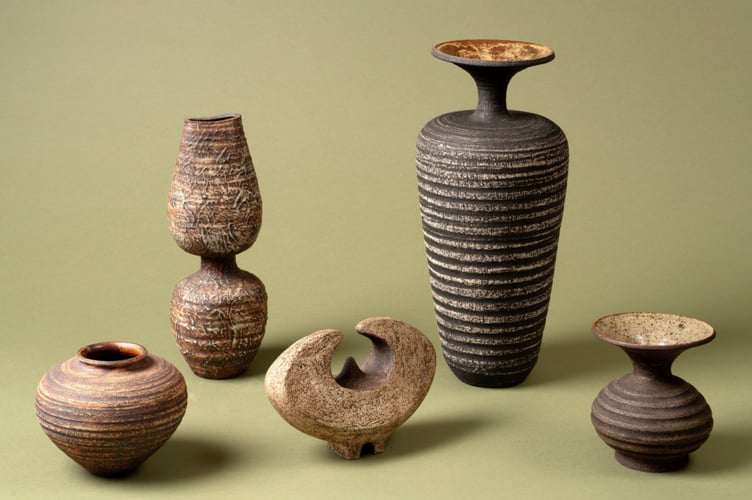
The prestigious Fine Art Society has just launched the biggest ever exhibition of the works of Waistel Cooper, one of the country’s most significant potters, who for many years developed his craft in and around Porlock.
For the next month, the society has cleared its galleries in London and Edinburgh to showcase 67 pieces produced by Waistel, many of them fired in his kiln when he lived in the secluded hamlet of Culbone, west of Porlock, in the 1960s and 1970s.
It was here that Waistel, inspired by the surrounding woodland flora and fungi, developed his distinctive style, producing pots and vases with rough, ribbed textures and fired in earthy organic tones. Waistel was a pioneering potter who, from his secluded West Somerset pottery, helped lead a revolution against the fashion for elaborately glazed and decorative pots.
Waistel was born in Ayr in 1921 and had first studied pottery at the Edinburgh School of Art. After the Second World War, he moved to live in Iceland where he first fired earthenware pots inspired by Mayan and Aztec designs.

In 1950, Waistel returned to live with his parents in Porlock, building a kiln in the garden of their house in Bossington Lane where he experimented with stoneware and wood ash glazes. It was from here that his skills were first recognised.
Galleries in London started to exhibits his pots, they were sold in top London stores such as Liberty’s and Heal’s, and in 1959 his pottery was selected for the exhibition British Artist Craftsmen and shown alongside works by Henry Moore, John Piper, Barbara Hepworth and Elizabeth Frink.
In 1960, Waistel moved a few miles west from Porlock along the coast to Culbone, where his future wife Joan, a noted psychologist, was already living at the lodge built by the Lovelace family. Here Waistel produced many of the exhibits now being exhibited in London and Edinburgh during his most creative and successful years in the 1960s.
After Joan died in 1982, Waistel moved to Penzance, where he opened a small gallery in the Barbican. Since his death in 2003, his work faded into obscurity but his reputation has recently been revived thanks to the fresh research and advocacy of Tim Williams, who has his own art gallery in Lynton. Tim’s passion for Waistel’s pottery has been the driving force behind these two prestigious exhibitions.
Comments
This article has no comments yet. Be the first to leave a comment.