
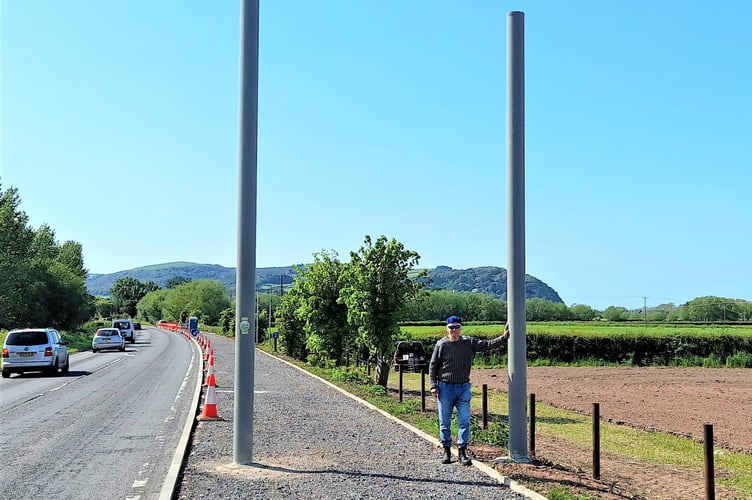
LOCAL environmentalists were up in arms this week as Somerset Council’s Highways Department began building a massive motorway-style directional sign on the picturesque A39 on the outskirts of Dunster.
Protestors claim that the sign, higher than a double-decker bus, will be a “monstrous blot on the landscape” and will seriously damage some of the area’s most iconic views.
“The overwhelming view is that this sign - which will simply point the way to Dunster, Dunster Castle and Dunster Marsh - will be far too big for its surroundings and will impact very badly on the views of Dunster Steep, Conygar Tower and the approach to Minehead,” said retired chartered landscape architect Christopher Miller, who is leading the protest.
“There is absolutely no need to have something which is so high, so monstrous and so out of proportion. We are hoping that common sense will prevail at the highways department before this folly actually becomes a fait accompli.”


“It is complete overkill at huge cost and why such a massive sign is needed is completely beyond us.”
Mr Miller added: “From Dunster Steep, driving west, there is already more than adequate signage. The same can be said of signage leaving Minehead. Existing signage is on the limit of acceptability in terms of its physical dimensions, quality and content. I believe additional signage - and certainly not on this scale - is entirely unnecessary.”
Minehead Conservation Society and Exmoor National Park Authority have also expressed their concern.
A Conservation Society spokesperson described the proposed sign as “a monstrosity which will blight the entry to Minehead.”
A spokesperson told Mr Miller: “The final size of the sign and associated posts is dictated for us. Following the guidance is a safety requirement.
“The previous signage was mounted much lower than the new sign due to the available sideways clearance to the previous footway.
“While we understand your concerns, we have reduced the size of the signs as much as possible by using the lowest advised text height and to ensure that the sign is compliant and safe for all road users. We would be unable to reduce the size of the sign any further.”
In reply, campaigners this week put forward an alternative plan which would involve moving the sign’s southernmost support pole from the edge of the road to just inside an adjacent field. This would keep the sign clear of the cycle path and allow it to be lowered to an acceptable level.
Mr Miller said he had not yet received a reply to this suggestion. He added: “I trust an acceptable solution can be found, as it is not too late, given a modicum of focus. Proper planning could have avoided all this.
“All we ask is that the height be drastically reduced so that the sign is not a blot on the surrounding countryside.”
In their submission to the highways department Minehead Conservation Society said: “We are deeply concerned by the erection of two huge posts that have appeared on the recently installed cycle path. They look like motorway stanchions and yet they are on a rural entry to a small West Somerset town.
“Does County Highways not have someone to advise them on landscape aesthetics? This monstrosity will blight the entry into Minehead and be seen across the fields of Dunster Marsh.
“Please can you tell us exactly what these poles have been installed to support and rethink the necessity for them? We are proud of the entry to Minehead and do not want it permanently marred.”
A National Park spokesman has told Mr Miller that as the A38 site is just outside park boundaries they had no control over signage. However, it appeared that the new signs “would be somewhat large” and the park authority had contacted Somerset Council asking for a meeting to discuss the matter.
Mr Miller urged anyone who shares the concerns to email their comments to Somerset Council.
Comments
This article has no comments yet. Be the first to leave a comment.