
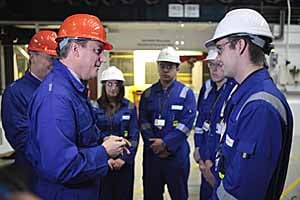
WORK could resume on the Hinkley C site near Stogursey in the spring after the Government finally agreed a price guarantee for the electricity generated from the proposed new plant.
Prime Minister David Cameron was joined by bosses from French energy giant and prospective Hinkley Point C developer EDF Energy at the Hinkley site on Monday.
The Government had been in protracted talks with EDF over the deal for months, with the stalemate resulting in preparatory work coming to a halt on the site earlier this year.
And it seems work on the West Somerset station - the first new nuclear plant in Britain for a generation - could resume in the early half of 2014 following Monday's announcement.
 Carols and entertainment amid late night shopping as Porlock Christmas lights go on
 McCarthy Stone retirement apartments refusal means Minehead Post Office stays
 Santa arrives by sea with touch of magic for Porlock Weir inaugural festive afternoon
.jpeg?width=209&height=140&crop=209:145,smart&quality=75) Carhampton public house reopened as four generations of family return to roots
Carhampton public house reopened as four generations of family return to rootsMr Cameron described the deal as a "very big day for our country" and said he hoped Hinkley C would be the first of many new nuclear power stations in Britain.
He said: "This deal means £16 billion of investment coming into the country and the creation of 25,000 jobs, which is brilliant news for the South West and the country as a whole.
"As we compete in the tough global race, this underlines the confidence there is in Britain and makes clear that we care very much open for business.
"This also marks the next generation of nuclear power in Britain, which has an important part to play in contributing to our future energy needs and out longer term security of supply."
Although EDF Energy already has planning permission to build Hinkley C, it had to secure a price guarantee from the Government for any electricity generated at the new plant before being able to take the project forward.
The energy firm has also yet to confirm a financial partner for the multi-billion pound development, although the company is known to be in talks with potential Chinese investors.
Last week, Chancellor George Osborne smoothed the way forward when he announced the Government would allow Chinese companies to take a stake in British nuclear power plants.
The news sparked widespread speculation that Hinkley C could become the first "China deal".
West Somerset Council leader Cllr Tim Taylor, who was at Hinkley to meet Mr Cameron on Monday, said the Government deal was "hugely positive, timely and very welcome".
"From our council's perspective we already have a series of programmes in place providing all sorts of opportunities for local businesses to benefit from being in the supply chain and local people to be trained to become part of a skilled workforce.
"We will continue to work hard to ensure that our communities and businesses are well placed to take advantage of all the opportunities which the project will undoubtedly bring.
"Our council will use the resources provided to us from the development to create a sustainable legacy for our community," Cllr Taylor said.
But not everyone welcomed the news, with anti-nuclear campaigners from pressure group Stop Hinkley branding the Government as "reckless" for allowing Chinese investment into the UK's nuclear power sector.
Spokesman Nikki Clark said: "The Coalition Government, having dug themselves into a hole, desperate as they are to implement their half-baked energy strategy, it seems don't know when to stop digging.
"They'll go to any lengths to create more nuclear power stations.
"We feel that bringing in an authoritarian regime such as China is a step too far.
" . . . We feel it is a recipe for disaster."
If built, Hinkley C would be the first new nuclear power station since 1995.
But even with an electricity price guarantee in place, the deal still has to be approved by the European Commission as EU State Aid rules make it illegal for Governments to subsidise nuclear power.
EDF is also facing two judicial reviews on its plans for Hinkley C, one from environmental group Greenpeace and the other from the Irish National Trust.
Henri Progolio, EDF group chairman and chief executive, said the deal would significantly strengthen the industrial and energy co-operation between France and the UK.
He said: "This project will deliver a boost to the economy and create job opportunities on both sides of the Channel and will enable the United Kingdom, a country in which EDF is already the leading producer of electricity, to increase the share of carbon-free energy in its production mix."
Comments
This article has no comments yet. Be the first to leave a comment.