
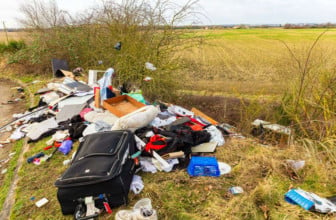
FLY-TIPPING in the West Somerset countryside has more than doubled in the past year and has reached a peak this winter, according to the latest DEFRA research.
Tippers are taking advantage of dark winter evenings to dispose of their rubbish on agricultural and private land, putting a heavy legal and financial burden on farmers and landowners.
Councils have reported that they have seen a surge of fly-tipping during January as people get rid of Christmas holiday waste.
And this week, local MP Ian Liddell-Grainger said that tougher controls were long overdue and too many rogue operators were slipping through the net of existing legislation.
 Programme to build Exmoor farming resilience backed by Royal fund
 Somerset Council says extra money needed or it may not be able to repair potholes
 Changes coming to recycling collections for residents in communal accommodation
 Bridgerton-stye ball will raise funds to support work of St Margaret's Hospice
According to DEFRA, 55,162 fly-tipping incidents were recorded across the South-West region in 2020/21, up from 50,506 during the previous 12 months.
Incidents in the Somerset West and Taunton Council area increased from 434 in 2019-20, to 997 in 2020-21.
"Fly-tipping is an unwelcome blight on our countryside and can represent far more than an inconvenience to victims of the crime," said Rupert Wailes-Fairbairn, of rural insurance broker Lycetts.
"Incidents not only pose significant environmental and human health risks, but also a legal and financial burden for farmers and landowners.
"Although local authorities will usually pay the clean-up costs of clearing waste from public land, the responsibility for removing waste from private land falls squarely on landowners. If they fail to do so, they can face prosecution."
Clean-up bills per incident average about £1,000, according to the National Rural Crime Network, but large-scale incidents can cost upwards of £10,000.
Mr Wailes-Fairbairn added: "Prevention is better than cure and steps should be taken to ensure access to land and fields is restricted, where possible, with physical barriers.
"Gates should be locked when not in use and although witnesses of fly-tipping incidents should not approach the perpetrators, by cutting back hedges and installing exterior lighting, visibility for the landowner can be notably improved.
"The installation of security cameras can also act as a deterrent and help in securing successful prosecutions."
Mr Liddell-Grainger said waste crime was now estimated to cost the economy more than £900 million a year with local authorities recording more than a million incidents of fly-tipping annually and there was barely a farmer or landowner who had not experienced fly-tipping in recent years.
"It is particularly prevalent in sparsely-populated rural areas where it has a commensurately greater impact on the environment," he said. "And while there have been successful prosecutions they have been all too few and the fly-tippers know full well that the odds remain stacked firmly in favour of them getting away with it."
Mr Liddell-Grainger said no new measures would be effective unless they came with additional resources. "It is pointless bringing forward new legislation if the regulators lack the ability to implement it.
"It is manifestly unfair that farmers should have to bear the cost of removing waste someone else has dumped on their land.
"It also makes no sense to allow an individual to dump garden waste free of charge but then to charge him for accepting building waste that has arisen because he has been carrying out home improvements.
"That kind of disparity only makes it more likely that people will choose the roadside verge or the field gateway as a cheaper and easier method of disposal."
Comments
This article has no comments yet. Be the first to leave a comment.