
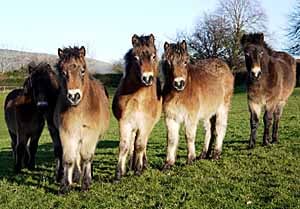
A MAJOR new initiative to prevent the slaughter of moorland foals from the iconic Exmoor pony breed has been launched by a West Somerset farming couple.
Luccombe-based breeders Nick and Dawn Westcott, who own Holtball Exmoor Pony Stud and who founded the Exmoor Pony Club, say their aim is to give foals from the endangered and ancient breed a lifeline.
And they want to prove that with the right socialisation, handling and promotion there is a market for them in the wider equestrian world.
Promotion of the Moorland Exmoor Foal Project comes just weeks after the publication of a report which raised the idea that the breed could be farmed for meat like cattle and sheep for sale to local hotels and restaurants.

-at-Holnicote-Estate-Somerset-National-Trust-Images-Nick-Upton.jpeg?width=209&height=140&crop=209:145,smart&quality=75)

North Devon vet Peter Green's study on the status, welfare and future of the free-living ponies within the Exmoor National Park concluded that changes needed to be made in the present system of management, husbandry and registration.
But it takes no view on the horsemeat suggestion, which was made by several contributors to his report, including some Exmoor Pony Society committee members and moorland herd owners.
The Westcotts describe the suggestion as "alarming" and believe it is not a route that should be followed.
The couple blame "continuing red tape" with the registration and inspection system for Exmoor Ponies, including DNA verification, testing, inspections, micro-chipping and passporting, for making it difficult and expensive for moorland herd breeders to sell their young stock.
The new project has so far taken at least 15 uninspected foals off the moor and given them the chance to find homes.
"Nine of the foals have been found homes," said Dawn.
"We decided to take the entire progeny from Herd 67 from Buscombe because after checking out the foals on the moor we realised they were all of far too good quality to slaughter.
"If we hadn't taken them all they would have been culled as no other buyers were prepared to take them uninspected."
The stallion running with the herd the previous year was the legendary Moorland Kingfisher - now dead.
Ignoring "discouragement" from various experts who believed the foals were likely to have been sired by rogue colts dumped on the moor, the couple remained convinced that they were the offspring of the stallion.
And they were proved right when DNA testing confirmed seven of them had been sired by Moorland Kingfisher, with the DNA of a further three of the same quality yet to be established.
Pivotal to the new project's success is the socialisation training programme which improves the wild foals' chances of being re-homed.
"While some people don't want the challenge of taking a wild foal straight off the moor, they are very interested in buying one once they've been through a few weeks of gentle socialisation and started to trust humans," said Dawn.
"We use positive, trust-based methods of horsemanship and work with them initially at liberty.
"They learn to approach us, accept being touched, recognise a feed bowl and, most importantly, come in from the pasture when asked.
"Once they've learned not to panic and start to understand the behaviour expected from them in their new domestic life, they become far more appealing to potential owners."
The Westcotts believe that new rules meaning DNA testing, microchipping and inspection of wild foals to ensure they meet the Exmoor pony breed standard is no longer carried out at the same time is adding to the overall cost for moorland herd owners, with the increased number of forcible restraints also unhelpful for any subsequent socialisation.
And the lack of inspection once the foals have been gathered off the moor also affects farmers' ability to sell them.
"With the continuing red tape it is proving to be a struggle to get these foals their rightful recognition and registration as Exmoor ponies," said Dawn.
"It is making it difficult to sell them as buyers want to know if they're getting a fully registered Exmoor pony or not."
Last November the Free Press highlighted concerns raised by moorland herd owner Rex Milton that delays in DNA test results were costing him hundreds of pounds in feed for his young Exmoor ponies and preventing him from selling them on.
He claimed that bureaucracy was making breeding in the ponies' native area almost impossible.
At the time, the Exmoor Pony Society, which was set up in 1921 to establish a stud book so that only ponies with a sire and a dam listed could be classed as pedigree registered Exmoors, said it was doing all it could to reduce the timescales.
It said it was EU and Defra regulations and not the society that stipulated that all moorland-bred ponies had to have verifiable parentage, with the law also now requiring ponies were microchipped.
And it said all elements had to be completed before a passport securing registration could be issued.
But the Westcotts believe the future of around 100 wild foals on the moor is at risk because of the current system.
"We felt we needed to set up this project as we couldn't bear to see so many beautiful moorland foals facing slaughter," said Dawn.
"With the right handling and preparation they are extremely marketable ponies - strong, well conformed, beautiful, intelligent and highly trainable.
"It's just a question of helping them cross the bridge from the moor to a good home.
"It's been a daunting undertaking but thoroughly worthwhile and there is immense satisfaction in seeing the foals go off to good homes."
Dawn said moorland farmers were beginning to show interest in learning more about the project's socialisation programme.
"The best future solution is for more of them to be able to sell partly handled foals directly from the farm.
"With their co-operation and involvement and a better registration system, together with co-ordinated marketing and promotion, the future would look much brighter for moorland Exmoor pony foals."
The project currently receives no funding and relies on volunteers and donations to pay for the purchase of the foals, transportation, care, training and re-homing.
More information on its work and how to get involved is available at http://www.ExmoorPonyClub.co.uk">www.ExmoorPonyClub.co.uk.
Comments
This article has no comments yet. Be the first to leave a comment.