

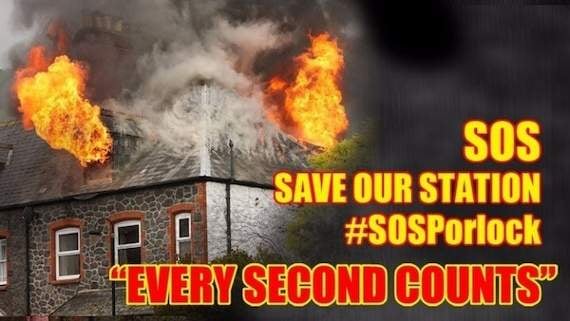
ANY cuts in fire and rescue services could have a serious effect on West Somerset’s ageing population and increase the danger risk to agriculture and tourism, Somerset county councillors have warned.
They were responding to Devon and Somerset Fire and Rescue Service’s (DSFRS) ‘Safer Together’ proposals which include closing Porlock fire station and redeploying other local engines and crews.
At its meeting last week, the council’s policy and place scrutiny committee said the fire service plans did not appear to fully appreciate the impact that cuts would have on deprived areas like West Somerset.
Councillors also criticised the consultation document which, they said, “appears to lead the reader’s thinking, has limited detail and does not allow for innovative thinking”.
 Minehead Tesco customers help charities feed thousands of families over Christmas
  Unique cancer fund-raising idea takes off in Stogursey after partner's life is saved
 Warning issued for whole of Christmas Day as strong winds set to hit Westcountry
 Three fire crews respond as barn full of straw catches light near Stogursey
The fire authority will make a decision on the proposals in November and implement them early next year.
In its formal response to the consultation, the county council
suggested that the fire authority could consider retaining a small fire safety vehicle at Porlock which could be kept somewhere other than in a DSFRS facility.
The council also claimed that socio-economic factors had not been adequately considered in the fire service proposals.
“Poverty is a very important factor to consider in fire risk, due to links between poverty and overcrowding, lack of home safety awareness and the likelihood of accidents to children in the home.
“Another risk factor essential to this debate is age. In parts of West Somerset more than half the population is projected to be 65 or older by 2033.
“The projected risk of fire does not appear to fully appreciate the impact of an ageing population, particularly when proposing to remove resources in West Somerset – an area identified as most impacted by this.”
The council also pointed out that much of West Somerset housing stock was old, with open fires and thatched roofs and more likely to fall victim to fire.
But it was not clear whether the full impact of tourism had been factored into the risk modelling.
The council asked: “What would be the impact of the closure of fire stations on the co-responder functions? This could have an impact on the more isolated stations such as Porlock.”
It also queried the proposal’s assertion that if a station was closed there were others within a 15-minute radius able to respond.
In the case of Porlock, the route to Minehead was served by a single access road which was frequently hindered by delays due to tourism, traffic volume and severe weather.
District councillor Andy Milne, leader of the Porlock station closure protest group, this week welcomed the country council’s response.
“They have got it absolutely right and we are grateful for their support,” he said.
“Clearly, local needs have not been taken into account. There are specific issues involving Porlock which make it a special case and we are delighted the country council has recognised this.”
Comments
This article has no comments yet. Be the first to leave a comment.