
DULVERTON businessman and district councillor Keith Ross this week leapt to the defence of the town's co-responders unit, saying he owed his life to their skill and commitment.
He wanted to publicly thank the specially trained firefighters after an attack last week on the service by the Fire Brigade Union (FBU).
Mr Ross, who runs The Tantivy, collapsed as he got up for work last month but received vital first aid from co-responders unit within minutes of his wife, Jan, dialling 999.
As reported in last weeks' Free Press, the FBU had criticised the co-responders scheme, claiming it did little more than bridge gaps left by an inadequate ambulance service.
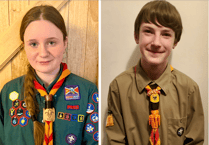 West Somerset scouting pair fund-raising to attend international jamboree in Poland
 Lack of donations threatens West Somerset annual classical music festival
 Marie Curie charity Great Daffodil Appeal launched in Parliament with MP support
 SEND students can follow supported internships path to find work on Exmoor
Ambulance chiefs hit back, praising the tireless commitment of the volunteers who ran the schemes, including those in Dulverton and Porlock.
Mr Ross said: "Within minutes of Jan making the call there were four Dulverton firemen knocking on the door.
"I was not in a very good state of health and although I was slumped on the floor their bedside manner was faultless."
Mr Ross was given entronox and oxygen until an ambulance arrived and he was taken to Musgrove Park Hospital, in Taunton, for treatment.
"The presence of the firemen was a great source of comfort to my wife, who was beside herself with worry.
"They carried out ECG, blood pressure and pulse readings and their prompt response was exactly what was needed," Mr Ross said.
He added: "Having well-trained firemen to offer support and comfort is essential in the absence of paramedics who are rushing to the assistance of a patient.
"I find it amazing that the Fire Brigade Union cannot understand this vital role in the countryside.
"I would like to put on record my thanks to the Dulverton crew and to Somerset Fire Brigade for taking this initiative and providing this first response service.
"They have attended several incidents which were life threatening and, without their early attendance, could well have proved fatal for many of us."
Although the two West Somerset schemes are manned by firefighters, co-responders can come from all walks of life.
In Williton, a recruitment evening was held in April to set up a community-based scheme following the success of a pilot project in Wiveliscombe.
Plans are also in the pipeline to set up a co-responders unit at Nether Stowey Fire Station.
All co-responder volunteers are trained in advanced first aid skills to ensure patients in isolated areas receive life-saving treatment within minutes of making a 999 call.
The aim is to administer treatment during the first few minutes of an emergency as, more often than not, it takes longer for an ambulance to reach a rural area than volunteers based within the community.
Somerset's chief fire officer, Clive Kemp, gave his full support to the co-responders and said he was aware the FBU's comments had disheartened many of the volunteers.
As a result, he had written to everyone involved with the schemes to praise their work but said he had not been surprised by the response of the FBU.
"They have been opposed to co-responders for a number of years, but we now have three schemes in place and they are working well," he said.
"These people are doing a good job and the FBU's comments were a real kick in the teeth for them."
One West Somerset co-responder, who asked not to be named, said the FBU's criticism had totally demoralised everyone involved in the scheme.
"The FBU has never made an attempt to visit any of the stations which operate this scheme to see how things are run," he said.
"Co-responders are an advantage to everybody and it is depressing to hear the FBU criticising us."
He said the West Somerset co-responders used a specially-adapted off-road response vehicle to attend emergencies, not a fire engine as claimed by the FBU.
He also believed that setting up co-responders units had saved some more rural fire stations from closure as their presence "justified having the station there".
He added: "We are all volunteers who are just trying to help our communities but thanks to the FBU there is now real depression in the ranks."
In a statement issued last week, FBU Somerset chairman Steve Underhill said: "When a member of the public dials 999 during a medical emergency they expect and deserve highly trained professional paramedics to arrive in a short space of time, not a crew of firefighters on board a fire appliance, who, although well meaning, can never expect to properly fulfil a specialist medical role in those vital first few minutes."
He accused West Country Ambulance Service of using co-responders just to improve their response time statistics.
But ambulance service spokesman Catherine Ferguson said co-responders were not intended to replace paramedics and it was a simple fact of life that ambulances could not be based "on every street corner".