
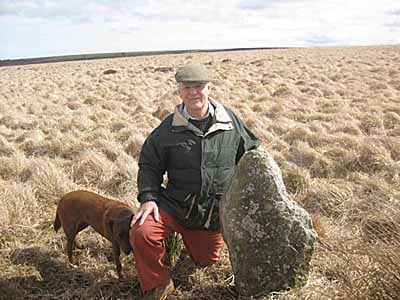
AN ancient boundary stone has been re-erected thanks to sharp-eyed landowner Chris Binnie when he was walking on Exmoor.
Chris noticed the stone, some four feet long, hidden under molinia grass on Porlock Allotment.
He contacted the national park office where arrangements were made for South West Archaeology to carry out a small excavation and the national park field services team re-erected the stone.
Rob Wilson-North, head of the historic environment team at the national park said: "We are very grateful to Chris Binnie both for finding this important stone and then kindly agreeing to fund the external costs incurred in the project to restore it to its rightful position.
-Chloe-Hadjimatheou-Rachel-Jo.jpeg?width=209&height=140&crop=209:145,smart&quality=75)

"The area known as the Royal Forest of Exmoor has dominated the Exmoor landscape for nearly 1000 years and for much of that time was owned by the King who marked the boundary of his land.
"It functioned as a larder for the needs of the Crown and Royal Court as well as becoming a valuable source of income through headage payments for masses of livestock which were grazed there from all around Exmoor during the summer months."
The area was subject to Forest Law and during the medieval period this was strongly enforced. The boundary of the forest became very important at this time and was regularly perambulated to ensure that it was being respected.
Many of the boundary markers such as ancient barrows, standing stones, trees and other natural features, can still be found today and are an important legacy of this time.
Chris said: "It was very exciting to find this wonderful link with Exmoor's distant past and it was rewarding to work with the national park authority to help ensure that the stone was surveyed and re-erected for future generations to enjoy."
The famous circular long distance walk, the Exmoor Perambulation, which marks the forest boundaries and dates back over 725 years, took place on Saturday.
The event also saw the launch of a leaflet about the history of the Royal Forest boundary.
Comments
This article has no comments yet. Be the first to leave a comment.