

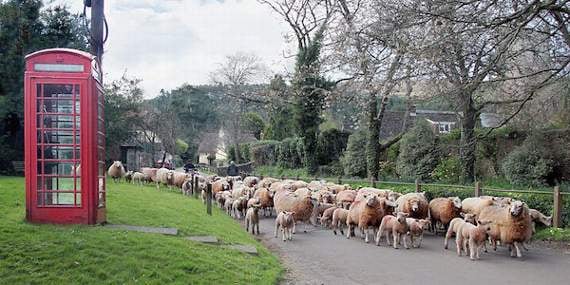
LUCCOMBE’S 80-year-old traditional village telephone-box could be made into a “listed building” to save it from being axed by BT if an Exmoor National Park Authority move is successful, it was revealed this week.
Residents of the 157-strong National Trust village are up in arms after BT announced that the box was redundant and would be removed, despite having promised that it would be left in place after the parish council objected to a similar proposal last year.
BT claimed that Luccombe now had mobile-phone coverage and had no need of a public phone. This is vehemently denied by residents, who say there is no signal from any network and that the box is a vital link to the outside world in the case of an emergency.
It was believed that a mobile-phone antenna installed in the church tower was vetoed by the park authority on the grounds that it would disturb a bat colony.



This week, local MP Ian Liddell-Grainger added his weight to the campaign by saying: “Last year’s proposal to remove the kiosk was based on an assertion that there is a mobile-telephone service in Luccombe. There isn’t.”
Parish council chairman Henry Harington told the Free Press that the consultation on the future of the phone-box closes at the end of August: “We went through this whole pantomime last year, showing that the figures on which BT relies to assess mobile coverage in Luccombe were simply not true.
“This year we have had to repeat the process as BT has again said it wishes to remove the telephone box and we have lodged the strongest possible objection with West Somerset and Taunton Council.”
sted. It is part of the landscape of the village. The park has had one application turned down but is appealing against the decision.”
A spokesman for the village website said: “Living in a place with no mobile signal and unreliable broadband means that this phone box is very much needed, and unless you live here this can be difficult to comprehend.”
The box now has a BT notice which reads: “We are thinking about removing this payphone. Our research shows that it just isn’t used enough for us to carry on running it. Because of this, we think we should remove it.”
A BT spokesman added that they were offering communities the chance to adopt obsolete traditional phone-boxes for £1 and transform them into “something inspirational”.
He added: “Most people now have a mobile phone and calls made from our public phones have fallen by about 90 per cent in the past decade.”
Mr Liddell-Grainger said Exmoor National Park Authority, the National Trust and BT must work together to find a solution because the present situation was clearly intolerable.
“Mobile company maps show a signal in Luccombe. Anyone on any of the networks will show you there is no mobile signal anywhere in the village, and especially not in the centre by the telephone box,
“Luccombe’s inhabitants must feel they are living in some dreadful fantasy world where common sense has ceased to exist,” he said.
“Virtually all the phones in the village are digital so if there is a power cut they won’t work and without a functioning public phone box people will have no way of calling for help if an emergency arises.
“Some people might argue that that would be an extremely rare combination of circumstances but history shows us rare combinations of circumstances do occur, often with devastating consequences.
“BT must leave that phone box in place until alternative communications can be provided and I am looking to the National Trust and the National Park to work together on that.
“Unfortunately the national park authority has a record of talking up the need for better internet and mobile phone coverage across the moor but then adopting an obstructive attitude when it comes to installing the actual hardware needed to provide it.
“I understand its legal duty to protect and conserve wildlife but that should not be prioritised at the expense of people’s safety.
“This is a situation where heads really need to be banged together with a certain degree of force to arrive at a workable solution.”
Responding to Mr Liddell-Grainger’s comments, an Exmoor National Park Authority spokesperson, said: “We support the ongoing provision of phone boxes in our villages. Many of these phone boxes are iconic in nature, are much loved and are highly valued as part of the national park’s heritage.
“They also offer important safety cover where there is often no phone signal and they provide a vital lifeline for both local residents and visitors. With respect to the current proposal to remove the phone box in Luccombe , the authority will be objecting to its removal.
“The topography and geography of Exmoor provide some of the most outstanding landscapes in the country which we all benefit from. They do, however, present some challenges for modern communications technology, and we are committed to working with all parties to find appropriate solutions.
“Over the last five years, well over 80 per cent of applications for telecommunications installations have been approved and we also worked proactively to secure the roll out of superfast broadband, with greater coverage available on Exmoor now than many other rural locations in the South West.
“Regarding the claim that we have refused planning consent for an alternative telecommunications system involving a mast on the church at Luccombe, this is not correct.
“Officers were exploring with the applicants potential issues regarding bats, but the applicants withdrew their application before the authority had determined it, or even reached a position where we could indicate a likely outcome.”
Comments
This article has no comments yet. Be the first to leave a comment.