

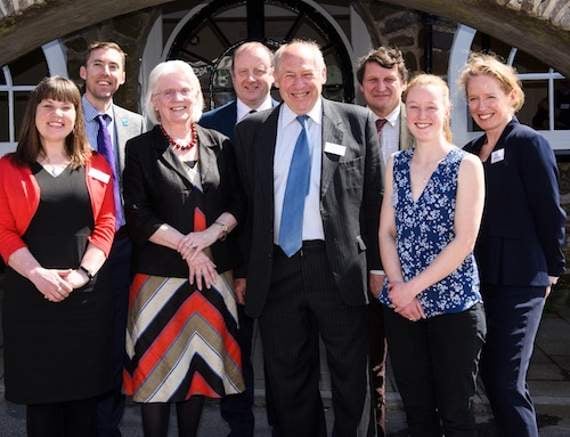
Commissioned by The Exmoor Society, Robert Deane and Anne Walker outlined some of their findings.
Robert, of Rural Focus Ltd, had also produced Exmoor’s Ambition, an agri-environmental scheme tailored to Exmoor and the Register, trialled on three farms, would add to it as well as being of practical use in other areas.
The conference, in Dulverton Town Hall, was on the theme ‘Beef, Birds and Beauty – A New Future for National Parks’.




Delegates heard that the Government’s 25-year Environment Plan stated that the creation of designated landscapes had been one of the most outstanding environmental achievements.
Rachel Thomas, chairman of The Exmoor Society, said Plan also announced the setting up of a 21st century Hobhouse Review of National Parks and AONBs and hoped that there would be an imminent announcement of its chairman and purpose.
She said the 1947 Hobhouse Report still had messages that resonate today.
It was clear that national parks were created for the nation’s benefit and wellbeing and should be limited in number to 12 and near centres of population.
The two statutory purposes were conservation of natural beauty to be protected through the town and country planning system, and enjoyment for all encouraged by the provision of facilities.
There was a recognition that many demands on land use should be controlled, ranging from afforestation to radio and radar communications and outdoor advertisements.
She said: “Much to the surprise of some people nationally because of its fragility, Exmoor has survived as a national park and the Exmoor described by Hobhouse is still recognisable today.”
The president of the Landscape Institute, Merrick Denton-Thompson, emphasised that it was an important moment in time for national parks. Their landscapes were a by-product of a used and long-settled land.
In upland national parks, like Exmoor, the farming system of extensive grazing was responsible for the varied landscapes with rich terrestrial habitats but a highly marginalised system of management.
He outlined important areas that needed to be critically watched. These included tough negotiations worldwide for sustainably-produced food, climate change, population growth in cities disconnected from the rural world, the regulatory system, natural capital accounting and the chemicalisation of the landscape.
He argued that Department of Environment, Food and Rural Affairs (Defra) had not looked after farming interests, had no clear agenda for the countryside and was not accountable locally.
Finally, he emphasised the importance of geographical places and their landscape character and, as such, Exmoor and other national parks were entities in their own right and national treasures because of their special qualities.
Sarah Howes, of Plymouth University, said: “National parks are national health and wellbeing assets and more could be done to use their resources in helping people’s mental and physical health.”
By studying Dartmoor and Exmoor, she outlined that although they attracted families to visit them, there was still more that could be done for four hard-to-reach groups: the deprived, the isolated, the marginalised and children.
Access to green and blue spaces was essential for people’s mental health, even in rural areas where isolation on farms could lead to depression.
Nick Bruce-White, RSPB South West regional dDirector, outlined the critical role national parks played in recovering nature.
Trends across the UK in the loss of biodiversity were the same as trends within national parks, but not to the same degree. Exmoor, for example, had lost the ring ouzels and curlews but there was a positive message in that there had been some gains, such as the whinchat and cuckoo.
The varied habitats, ranging from moorland, Atlantic woodlands and the farm-grazed landscapes were all supporting associated species.
“There is now an opportunity for bigger, better landscape scale restoration for nature in Exmoor and other national parks,” he said.
Neil Parish, introduced by Robin Milton, chairman of Exmoor National Park Authority, outlined the importance of farming in the national park.
However, he said, there was a need to convince the Treasury that high quality products from farming had to be included in the monetary value of the food and drink industry.
Exmoor National Park Authority chief executive Sarah Bryan referred to the recently launched statutory Management (Partnership) Plan that sets a vision for Exmoor.
She said: “The Plan is for all those who care about Exmoor: the place, its communities and the benefits the national park provides to the nation.”