
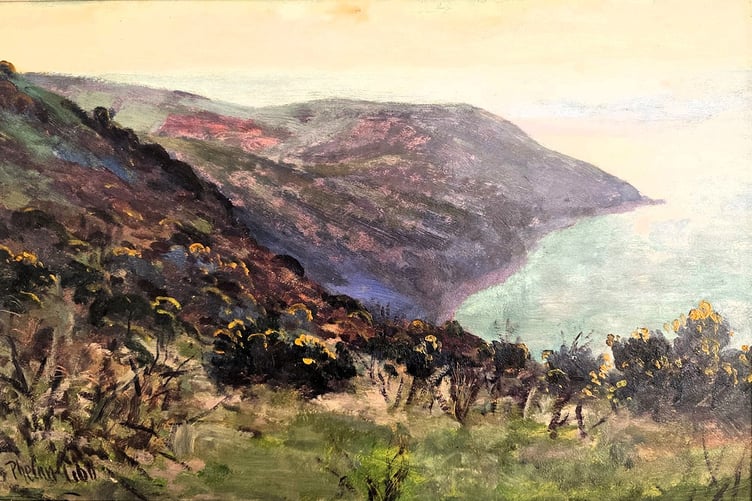
AN artist who lived and worked on Exmoor for many years before being largely forgotten for decades, has now been rediscovered and hailed as one of the pioneers of the British modern art movement.
An exhibition of the work of Harry Phelen Gibb (1870-1948), who had a house and studio near Malmshead, has opened in the Frestonian Gallery, Holland Park, London, until August 8.
It concentrates on the 25 years he spent in Paris where he was influenced by Paul Cezanne and other iconic artists.
Gibb moved to Exmoor after the First World War and produced acclaimed pictures depicting beauty spots including the Doone and Lynn valleys, Foreland Point, and Countisbury Common.

Several of these paintings are currently in the Doone Gallery, Malmshead.
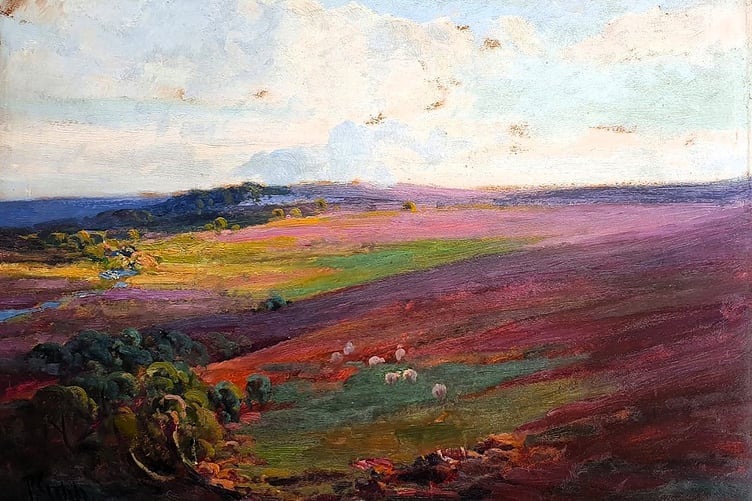
Born in Northumberland, Gibb studied in Newcastle, Edinburgh, Antwerp, and Munich and was associated with many of the defining artistic movements of the early 20th century, including Fauvism, Cubism, Pointillism, Vorticism, the Bloomsbury Group, and the White Stag Group.
A close friend of Gertrude Stein, he played an important role in introducing her work to British and Irish audiences.
Later, he was represented by the influential design firm Betty Joel and the pioneering art dealer Lucy Wertheim.Retreating to Exmoor, Gibb found inspiration in its dramatic landscapes, coastline, and rivers.
A keen fisherman and naturalist, he produced a remarkable body of work and is now regarded as among the most evocative artistic records of this corner of Exmoor.
But at the time he was dismissed as a forgotten man on the artistic scene, suffering financial hardship and criticism of his ‘new art’.
A gallery spokesperson said: “We hope the exhibition will restore Gibb to his rightful place in the history of British modernism.”
Harry Phelan Gibb - A British Modernist Rediscovered: The Paris Years, is at the Frestonian Gallery, London, W11 4BE.
Comments
This article has no comments yet. Be the first to leave a comment.