

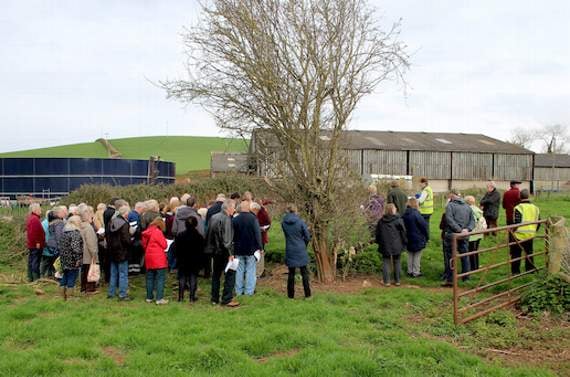
MORE than 100 people were transported back over 1,000 years on Saturday when they had a rare chance to visit what is claimed to be the most important medieval iron-ore smelting site in Western Europe on private farmland in Carhampton
Consultant archaeologist Nancy Hollinrake, who led a guided tour of the Eastbury Farm excavations, was the author of a definitive report on the site when it was first planned to build a bypass through the village in 1994.
She recalled the discovery of the remains of the lost monastery of St Carantoc, a tenth century Welsh saint, a mass burial ground and buildings and artifacts dating from the sixth to the tenth century.
In an illustrated talk in Carhampton Recreation Hall in aid of the village’s new heritage centre, Mrs Hollinrake said the excavations had uncovered the remains of a range of buildings and a large and sophisticated iron smelting site, as well as shards of pottery from as far away as the Eastern Mediterranean.

The digs were sparked off by a local farmworker who had pointed out the area of a field where skeletons were said to have been found.
Nearly 20 trenches were dug and “dense accumulations of archaeological features and deposits” were found. Many of these are now in the Somerset Heritage Centre.
Mrs Hollinrake said that, of the 500 sites she had excavated, Carhampton was probably the most remarkable: “There is still a huge amount left to discover and I am hopeful that one day we will have an opportunity to revisit it.
“If I could choose only one site to do more work on in the future, this would be it.”
Event organiser Jane Jones said: “Visiting the site of remains going back thousands of years was a revelation – even to those of us who live here.”
Comments
This article has no comments yet. Be the first to leave a comment.