

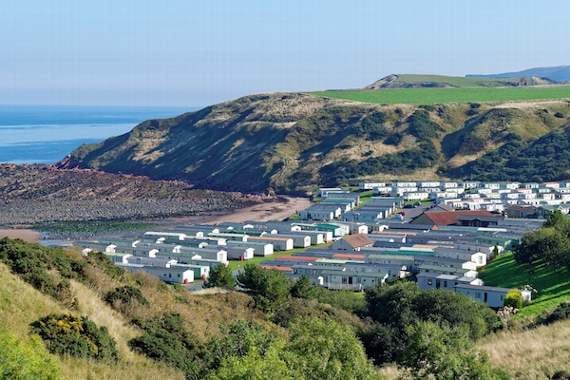
WEST Somerset caravan sites could soon get a major financial boost by being allowed to stay open all year to provide homes for hundreds of Hinkley Point workers.
West Somerset Council’s licensing committee this week discussed the possibility of lifting the rules that restrict caravan occupancy to ten or 11 months to help cope with an influx of nuclear power station staff needing accommodation.
The number could reach 3,700 in two years’ time.
But committee members were worried that such a move could have a serious effect on tourism if visitors were crowded out by Hinkley shift-workers in rural caravan parks.




“It’s vital that there should be a proper balance between residential caravan accommodation and tourism,” said committee chairman Cllr Richard Lillis.
At the committee’s meeting on Tuesday, Cllr Lillis said there was already limited accommodation to cope with the arrival of Hinkley Point workers – and the situation was getting worse.
He said that to help cope with the problem, Sedgemoor District Council had recently temporarily relaxed its caravan licensing policy to allow 12-month occupation at a number of caravan sites and he suggested that West Somerset should consider similar action.
Andrew Goodchild, West Somerset Council’s assistant director for place and energy infrastructure, said that many Hinkley workers were already living in caravan parks.
“The issue is that sites have different licensing consents and planning permissions. There is no common policy and it is important to regularise the situation.”
He told the committee that a new campus site to accommodate 1,500 workers would not open until mid 2018, but meanwhile, the workforce was increasing and more accommodation was needed.
Even when the new block on the campus site was built, it would not accommodate all the influx of workers.
Mr Goodchild confirmed that Sedgemoor council had granted licences to sites “to avoid pushing workers into the private sector which could cause problems”.
He added that by 2020-21 the Hinkley workforce would peak at an estimated 5,600 and of these 3,700 would be moving to the area.
At least 600 workers would be in tourist accommodation within a 60-minute zone surrounding the development, 1,500 on the new campus, 750 in private accommodation, 400 in latent accommodation (spare rooms) and 500 will have bought their own homes.
“But we are not there at the moment and there are no fixed proposals at present,” Mr Goodchild said. “There are a lot of issues to bear in mind.”