
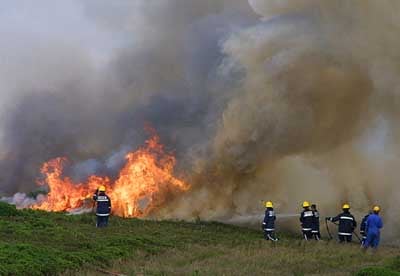
A SCATHING attack has been launched on the arsonist who caused the devastating gorse fire on North Hill, Minehead, which was still smouldering yesterday (Thursday), three days after it started.
The 30-acre blaze stretched fire brigade resources across the county, killed deer calves and destroyed vital habitats of rare birds and insects.
In a strongly worded statement, Exmoor National Park Authority said it was "disgusted and shocked" to learn the fire was probably started deliberately.
Some firemen called to fight the blaze were said to be traumatised by the sound of helpless deer calves screaming in pain and fear as the fire raged around them.
 Minehead Tesco customers help charities feed thousands of families over Christmas
  Good news as food hygiene ratings handed to 27 Somerset establishments
 Alderwoman honour for Christine Lawrence after three decades of public service
 Repairs to A396 Cutcombe Hill moved to nighttime work to avoid Snowdrop Valley clash
One deer was rescued by firefighters, who cared for the animal until a vet arrived to treat its burns.
Luckily, no people were injured, although around 20 holidaymakers were evacuated from the Camping and Caravanning Club site in North Hill Road as a precaution.
National park officer Dr Nigel Stone said: "It is not that this area should never be burned, but this uncontrolled, illegal fire has come at completely the wrong time for the important wildlife in the area.
"Dealing with a blaze like this will also have cost tens of thousands of pounds of taxpayers money and we are encouraging the police to take this matter seriously."
The affected area was the home to some 30 deer, many of which had young calves, Exmoor ponies and the very rare bird, the Dartford warbler.
Other bird species likely to have been hit in the middle of their nesting season include stonechats, skylarks and meadow pippits.
National Park conservation officer, David Lloyd, said: "We undertook a survey last year of the area and know that at least five pairs of Dartford warblers were nesting where the fire was and will have lost their nests.
"This is particularly devastating as this rare species was just beginning to settle in the area."
He added that reptiles such as slow worms, adders and lizards would also have perished in the flames, as well as butterflies and insects.
It is estimated that it could take up to eight years for the area to recover.
The fire started early on Monday evening and soon 100 firefighters, eight fire engines and numerous support appliances from Minehead, Porlock, Williton, Lynton, Wiveliscombe, Taunton and Bridgwater were at the scene.
By 10.30pm that night the fire had been brought under control, but two crews remained on the hill damping down the five acres of gorse that had been affected.
By 11am the following morning, crews from Minehead, Glastonbury and Dulverton were still damping down.
However, the wind picked up on Tuesday afternoon and soon the sound of sirens filled the air again as 15 engines raced back to the scene.
It was then the decision was taken to evacuate the campsite, but such was the speed of the blaze that holidaymakers were told not to collect possessions but to leave immediately.
Holiday site manager Bruce Baker said no-one was ever in any direct danger and he praised the emergency services for their response.
"The situation changed so rapidly, one minute we were being told there was no problem, then five minutes later the wind changed direction and we had to go," Mr Baker said.
Thankfully, the fire was brought under control before it reached either the campsite or nearby houses.
By the early hours of Wednesday morning six fire engines remained at the scene, damping down and dealing with small fires which continued to break out across the gorse due to the strong winds.
That number had increased to eight engines by Wednesday afternoon as the damping down operation continued. By midnight five engines remained and at 8am yesterday the brigade said the fire should be completely extinguished during the course of the day.
Fire brigade spokesman Andy Newland said throughout the incident firefighters were very much in the hands of the elements as the hot weather and high winds meant it was a particularly difficult fire to contain.
"This was a serious incident, which is, unfortunately, all too common on this type of land.
"These type of fires are notoriously difficult to fight and things can appear to be under control and then suddenly flare up again very quickly."
He thanked local employers for allowing many relief firefighters to leave their jobs to tackle the blaze and members of the Salvation Army who had provided the crews with drinks and snacks.
He also confirmed the fire had been started by a "doubtful cause".
It will now be up to conservationists to try and discover the true impact of the three-day blaze.
National park head ranger, Bill Gurnett, said: "If these fires get out of control not only is there impact on wildlife and landscape, but people's lives are put at real risk as are local houses and property."
West Somerset MP Ian Liddell-Grainger said the fire had destroyed what was one of the most beautiful parts of Somerset.
"This sort of fire does not only damage the environment it also affects the actual structure of the hill for years to come.
"The problem now is going to be getting the hill back to where it was before.
"I will be looking to the Environment Agency for compensation to re-seed the hill and will also contact the Department for Environment, Food and Rural Affairs to see what they can do," he said.