

LOCAL ambulances spent a total of 450 hours over the last year queuing outside Taunton’s Musgrove Park Hospital, waiting to discharge patients, West Somerset Council’s scrutiny committee was told last week.
One member described the figure as “shocking”.
“This is the equivalent of 45 ten-hour shifts,” said David Wilson, operations manager for the West Somerset division of the South Western Area Service Trust (SWAST).
“This is not as bad as some other areas but it is still bad and does have impact. No-one is to blame; this is just the system at the moment and we have to make the best of it. We are working hard with Musgrove Hospital to try and alleviate the situation,” he said.
.jpeg?width=209&height=140&crop=209:145,smart&quality=75) Refugees thank West Somerset folk as fourth anniversary of Ukraine conflict marked
Refugees thank West Somerset folk as fourth anniversary of Ukraine conflict marked Critics say dramatic fall in Somerset Council budget gap is 'smoke and mirrors'
 Anger continues over bid to by-pass cap on Somerset council tax increase
 Union says more Government money needed to recruit new Somerset firefighters
Cllr Rosemary Woods asked for assurance that patients with a life-threatening illness or injury would go to the front of the queue.
“Yes, definitely,” replied Paul Cleeland-Smith, staff officer to the director of operations.
“Crews tell the hospital while they are on route so that they are ready for them on arrival.”
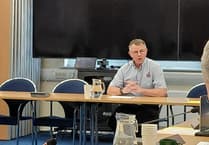
Mr Wilson and Mr Cleeland-Smith appeared before the scrutiny committee for a long question-and-answers session following an earlier meeting in November when SWAST representatives were asked to provide more detailed answers to the committee’s concerns.
Several members complained that they found the statistics confusing and there was concern that West Somerset was not being treated as high a priority as larger areas such as Taunton.
“If you received two emergency calls at the same time, one in Taunton and one in West Somerset, who would get top priority? Where would the ambulance go?” asked Cllr Mandy Chilcott.
“It is highly unlikely that the service would receive two identical calls at exactly the same time but both would have equal priority. The closest ambulances would be sent to each incident,” Mr Cleeland-Smith told her.
In its report to the committee, SWAST said the operational performance area that covers West Somerset consists of four ambulance stations – Taunton, Bridgwater, Ilminister and Minehead: “Due to the nature of emergency demand, theoretically any ambulance resource between Tewkesbury and Land’s End could attend any incident in the area.”
“The rationale for this is that the closest possible resource is always dispatched in the timeliest fashion depending on the urgency of the call. It is always appropriate to dispatch a suitable ambulance resource closest to the most serious call if they are free to attend.”
The trust said that the operational performance in West Somerset was ‘high achieving’. All stations were fully staffed and the operational output was often in excess of that commissioned.
However, between April 2015 and February this year the service had dealt with 39,284 incidents, up by 1252 from the previous year, and “the level of demand placed upon ambulance services is fundamentally unsustainable without new ways of working and investment”.
See the Free Press for more
Comments
This article has no comments yet. Be the first to leave a comment.