
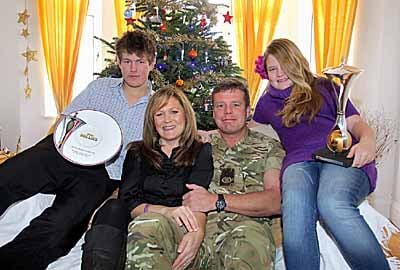
ROYAL Marine Paul Ryan has missed celebrating Christmas with his family too many times to recall.
But the turkey and tinsel festivities will have a special meaning this year as he will be at home in Minehead with his wife Sarah and children William, 15, and ten-year-old Maisie.
As reported in last week's Free Press, Sergeant Major Ryan won the accolade of Outstanding Marine in the Sun newspaper's annual Military Awards.
The honour was in recognition of the part he played in rescuing injured American airmen from the burning wreckage of a helicopter in Afghanistan.
.jpeg?width=209&height=140&crop=209:145,smart&quality=75)
And this week, as he enjoyed the start of a three-week break from his duties, he told the Free Press that this quiet family Christmas would be a special one.
Sgt Major Ryan serves with Norton Fitzwarren-based 40 Commando, who lost 14 marines on the last tour of duty, which ended in October.
And six of the fatalities were from his unit, Charlie Company.
"I feel I owe it to the men who lost their lives to remember them but also to enjoy Christmas with my family," he said.
"Charlie Company paid a high price on this last tour. I am very proud to be a marine but I am also very proud of my family and of the huge support from people in the Minehead area - it's been absolutely overwhelming."
The details of the incident in June which led to Sgt Major Ryan's award are still frighteningly fresh in his memory.
He had called for American support to airlift out a wounded marine who had been shot in the elbow, but as the seven-crew Black Hawk helicopter circled over the marines' base in Sangin, he head the sound of a rocket propelled Taliban grenade.
"I didn't see it hit but I heard it," he said. "Then we heard on the radio that it was going down."
The helicopter crashed around 200 metres outside the main gate of the base after the pilot used incredible skill to steer it away from a crowded bazaar.
Sgt Major Ryan and initially just a 15-strong team of men ignored the risk of the IEDs (Improvised Explosive Device) likely to be in their path and the danger from insurgents to race to the scene.
Within minutes a 100-strong crowd of local people had gathered, which quickly turned into several hundred.
"You never know who or where the insurgents are - one minute somebody can be holding a shovel and the next a gun.
"We were massively at risk but we knew we had to get straight there. The aircraft was on fire, the aviation fuel had caught alight and ammunition on board was exploding."
The sight of a door gunner hanging from the helicopter, trapped by his burning legs and fully conscious, is something Sgt Major Ryan said he and his men would not easily forget.
With only basic fire fighting equipment - and not enough of it - the marines made desperate attempts to reach the aircrew in the blazing fuselage, beaten back time and again by the ferocity of the flames.
But it was almost 25 minutes before the pilot and co-pilot, suffering serious head injuries and burns, and the door gunner - whose boots had to be cut off to free him - were eventually pulled from the wreckage alive.
Four of the aircrew died in the helicopter and in the end, just two survived the crash as the pilot died later from his injuries.
Sgt Major Ryan made two attempts himself to get into the helicopter before concentrating on leading and co-ordinating the complex rescue, which stretched over five hours.
And the following day, he was among the party that had to drive the bodies of the four crewmen who died in the wreckage back to the American base, again risking their lives along a notoriously dangerous stretch of road.
He was quick to praise the actions of all the men who took part, from the marines who had to throw a human cordon round the crash site to keep the victory-claiming crowds at bay to those who used jerry cans of water to douse themselves before plunging into the flames or shovelled sand on the blazing wreckage in a bid to fight the fire.
The helicopter burned all night and the site had to be secured from attacks from souvenir-hunting Taliban supporters for 48 hours.
"Everyone involved behaved outstandingly. We don't train to deal with helicopter crashes - you don't expect to be rescuing the rescuers.
"But when you see your brothers in arms in peril, you have to do everything you can to help.
"I take my hat off to everyone who played a part. Although it was my job to take charge, it is never down to one man.
"We saw some horrific sights. I very much relied on those around me and the Sun award was for them, as much as me."
Comments
This article has no comments yet. Be the first to leave a comment.